
Technology in Fertility Clinics: Transforming IVF Outcomes

Nearly 60 percent of American women under 40 now explore advanced fertility technologies for a more personalized path to parenthood. With emerging AI-driven solutions, clinics worldwide offer unprecedented accuracy and comfort in every stage of the process. Whether you are in Europe, Asia, or America, understanding how technology is transforming embryo selection, genetic testing, and treatment personalization could help you make more confident choices and reduce the stress often linked with fertility journeys.
Table of Contents
Key Takeaways
Point | Details |
Integration of Technology | Modern fertility clinics utilize advanced technologies like AI, genetic screening, and precise imaging to enhance reproductive outcomes and personalize treatments. |
AI in Fertility Treatments | Artificial Intelligence improves embryo selection and clinical decision-making, leading to increased success rates and individualized care strategies. |
Predictive Analytics for Personalization | Utilizing predictive analytics allows for tailored treatment protocols based on comprehensive patient data, optimizing IVF success. |
Cost and Patient Experience | Innovations in telemedicine and digital solutions are reducing costs and enhancing patient support in fertility care, making treatments more accessible. |
Defining Technology in Fertility Clinics
Assisted reproductive technology (ART) represents a sophisticated medical approach that transforms how individuals and couples address fertility challenges. Comprehensive medical techniques have revolutionized reproductive medicine, enabling advanced interventions that were inconceivable just decades ago.
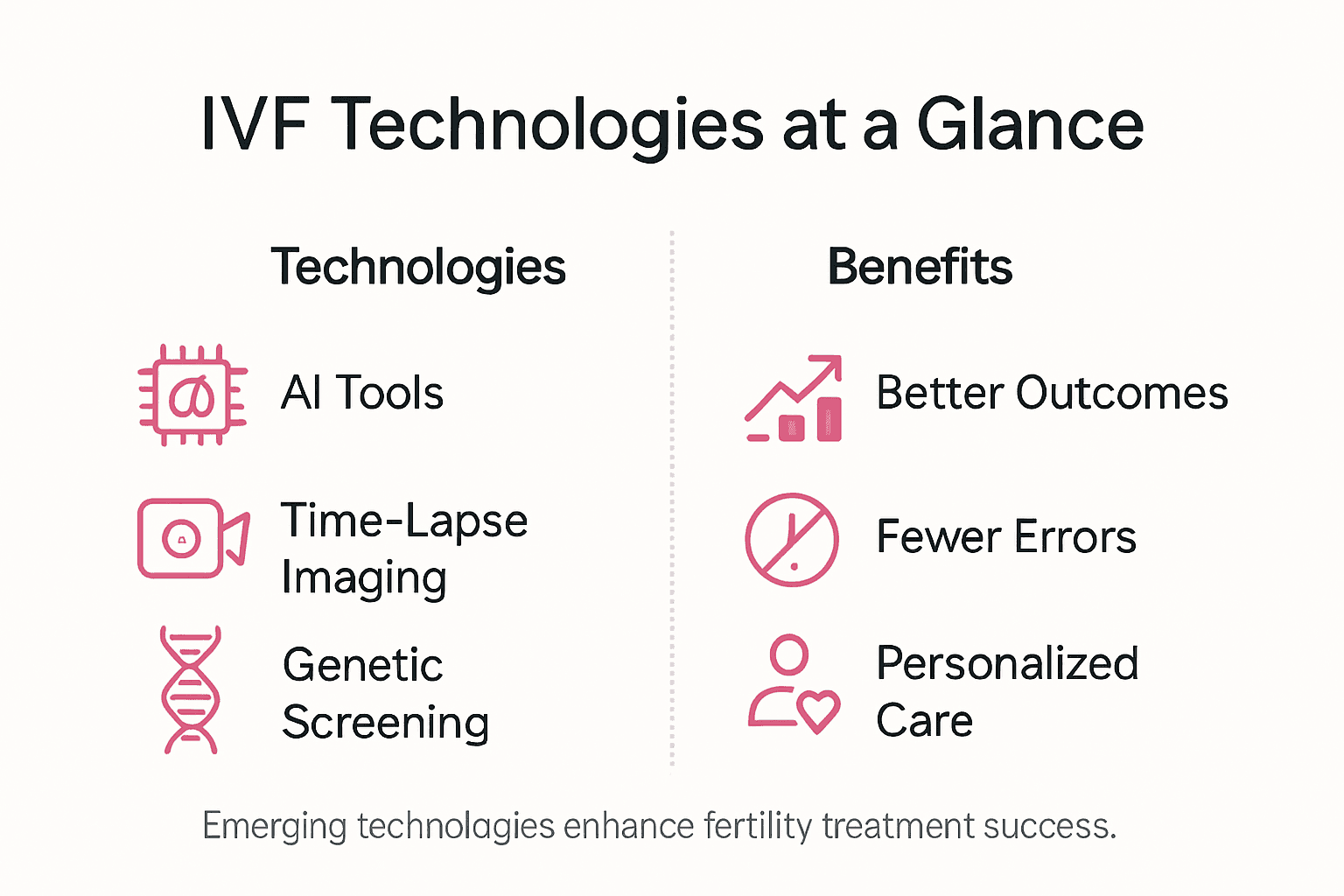
Modern fertility clinics integrate cutting-edge technologies across multiple diagnostic and treatment domains. These technologies include advanced imaging systems, genetic screening platforms, artificial intelligence algorithms, and precision laboratory equipment designed to optimize reproductive outcomes. Key technological innovations encompass techniques like preimplantation genetic testing, time-lapse embryo monitoring, and AI-driven embryo selection, which dramatically improve clinical success rates and personalize treatment protocols.
The technological landscape in fertility clinics now extends far beyond traditional medical approaches. Sophisticated diagnostic tools allow physicians to analyze genetic markers, assess egg and sperm quality with unprecedented precision, and develop individualized treatment strategies. Artificial intelligence integrated fertility solutions enable clinicians to predict potential challenges, recommend optimal intervention strategies, and enhance overall patient outcomes with data-driven insights.
Pro Tip: When exploring fertility technologies, request a comprehensive consultation that explains how specific technological approaches might apply to your unique reproductive health profile.
Here’s a summary of the major technological advances shaping modern fertility clinics:
Technology Type | Main Function | Clinical Impact |
AI Algorithms | Embryo selection, prediction | Higher success rates, personalization |
Genetic Screening Platforms | Detect genetic markers | Reduce hereditary risks |
Time-Lapse Monitoring | Track embryo development | Improved viability assessment |
Advanced Imaging Systems | Assess egg/sperm quality | More precise diagnostics |
Microfluidics | Sperm sorting | Enhanced fertilization potential |
AI-Driven Innovations in IVF Procedures
Artificial Intelligence is transforming reproductive medicine through groundbreaking technological interventions. Advanced machine learning algorithms are revolutionizing IVF procedures by providing unprecedented precision in clinical decision-making, embryo assessment, and treatment personalization.
AI applications in reproductive technology span multiple critical domains. These innovative technologies enable sophisticated analyses of follicular development, oocyte quality, and embryo potential with remarkable accuracy. Clinicians can now leverage complex computational models to predict pregnancy outcomes, optimize stimulation protocols, and select the most viable embryos with greater confidence than traditional manual assessment techniques.
The integration of AI into IVF procedures represents a paradigm shift in reproductive healthcare. Intelligent diagnostic tools systematically analyze extensive genetic and physiological datasets, providing clinicians with nuanced insights that were previously unavailable. By reducing subjective variability and introducing data-driven precision, AI technologies are significantly enhancing success rates and personalizing treatment strategies for individuals struggling with fertility challenges.
Pro Tip: Request a detailed consultation explaining how specific AI technologies might be tailored to your unique reproductive health profile and potential genetic considerations.
Personalized Treatment Using Predictive Analytics
Predictive analytics are revolutionizing fertility treatments by transforming complex medical data into personalized healthcare strategies. Machine learning models now analyze comprehensive patient datasets, including demographics and specific infertility factors, to generate incredibly precise treatment predictions with remarkable accuracy.
These advanced computational approaches enable clinicians to develop intricate, individualized treatment protocols that go far beyond traditional one-size-fits-all approaches. By integrating multiple data points such as genetic markers, hormonal profiles, age-related factors, and historical medical information, predictive analytics can forecast potential challenges and optimize intervention strategies with unprecedented specificity. Patients now receive treatment plans tailored precisely to their unique physiological characteristics and reproductive health landscape.
Artificial intelligence technologies are transforming quality control and decision-making processes in reproductive healthcare. These intelligent systems reduce human error, standardize complex medical procedures, and provide clinicians with nuanced insights that dramatically improve embryo and sperm selection protocols. The result is a more efficient, accurate, and personalized approach to fertility treatments that significantly enhances potential success rates for individuals seeking reproductive solutions.
Pro Tip: Request a comprehensive diagnostic consultation that includes a detailed predictive analytics assessment to understand your unique fertility profile and potential treatment pathways.
Compare how AI and predictive analytics transform fertility treatments:
Approach | How It Works | Key Benefit | Extra Consideration |
AI-Based Assessment | Analyzes images and data sets | Consistent embryo rating | Reduces human bias |
Predictive Analytics | Models patient data for forecasts | Individualized protocols | Optimizes interventions |
Enhancing Embryo and Sperm Selection Accuracy
Advanced sperm selection techniques are transforming reproductive medicine by providing unprecedented insights into gamete quality and potential. Modern laboratories now employ sophisticated methodologies like magnetic-activated cell sorting, microfluidics, and intracytoplasmic morphologically selected sperm injection to evaluate sperm characteristics with extraordinary precision. These cutting-edge approaches enable clinicians to identify the most viable sperm samples, dramatically improving fertilization potential.

Artificial intelligence has revolutionized embryo assessment by introducing data-driven evaluation methods that surpass traditional visual screening techniques. AI-based machine learning models analyze complex developmental markers, tracking embryo growth patterns, cellular morphology, and genetic indicators with remarkable accuracy. These intelligent systems can predict embryo viability and developmental potential more reliably than human embryologists, reducing subjective interpretation and increasing successful pregnancy rates.
The integration of advanced technological approaches represents a paradigm shift in reproductive medicine. By combining precise sperm selection techniques with intelligent embryo assessment algorithms, fertility specialists can now optimize treatment protocols with unprecedented granularity. These innovations enable more targeted interventions, reduce unnecessary procedures, and provide patients with more personalized and effective fertility treatments that significantly improve their chances of successful conception.
Pro Tip: Request a comprehensive consultation that includes detailed genetic and morphological screening to understand the most advanced selection techniques available for your specific fertility journey.
Reducing Costs and Improving Patient Experience
Policy solutions in reproductive healthcare are fundamentally transforming how fertility clinics approach cost reduction and patient engagement. By streamlining treatment pathways and implementing innovative digital strategies, clinics can dramatically lower financial barriers while simultaneously enhancing the overall patient experience. These approaches focus on creating more transparent, accessible, and supportive treatment environments that address both medical and emotional aspects of fertility journeys.
Digital innovations are playing a critical role in reshaping fertility treatment economics. Technological advancements like telemedicine and AI enable clinics to optimize resource allocation, reduce administrative overhead, and provide more personalized care at lower costs. These solutions create more efficient treatment protocols, minimize unnecessary procedures, and offer patients greater flexibility and convenience throughout their reproductive healthcare experience.
The convergence of technological innovation and patient-centered care represents a profound shift in reproductive medicine. By leveraging advanced digital platforms, artificial intelligence, and data-driven insights, fertility clinics can create more affordable, accessible, and emotionally supportive treatment ecosystems. This approach not only reduces financial strain but also addresses the complex psychological challenges associated with fertility treatments, providing comprehensive support that extends far beyond traditional medical interventions.
Pro Tip: Request a comprehensive cost breakdown and explore clinics offering flexible payment plans or innovative financing options to make your fertility journey more financially manageable.
Ethical, Safety, and Legal Considerations
Emerging legal frameworks in reproductive technologies are critically addressing the complex challenges facing modern fertility treatments. The reproductive healthcare industry must navigate intricate regulatory landscapes that balance technological innovation with patient safety, protection, and comprehensive legal oversight. These evolving frameworks aim to establish clear guidelines that protect patient rights, ensure medical transparency, and maintain rigorous standards for emerging reproductive technologies.
Global perspectives on reproductive ethics reveal significant variations in approaches to assisted reproductive technologies. International regulatory challenges highlight the need for harmonized standards that can address disparities in preimplantation genetic testing, cultural perspectives, and equitable treatment access. These complex considerations require nuanced legal approaches that respect diverse cultural contexts while maintaining consistent patient protection and medical integrity.
The intersection of technological innovation and ethical considerations demands continuous dialogue and adaptive regulatory strategies. Fertility clinics must proactively engage with emerging ethical challenges, implementing robust safeguards that protect patient autonomy, genetic privacy, and informed consent. This approach requires transparent communication, comprehensive risk assessments, and a commitment to maintaining the highest standards of medical and ethical practice in reproductive healthcare.
Pro Tip: Always request detailed documentation about a clinic’s ethical guidelines, safety protocols, and legal compliance before beginning any fertility treatment.
Discover How AI is Revolutionizing Your Fertility Journey
The challenges of navigating fertility treatments can feel overwhelming, especially when trying to understand complex technologies like AI-driven embryo selection, time-lapse monitoring, and predictive analytics. You want clear answers, personalized care, and real hope for success. At Aurea Fertility, we turn these advanced scientific breakthroughs into tailored treatment plans designed specifically for women under 40 with good ovarian reserve. Our approach integrates artificial intelligence to enhance IVF outcomes while reducing stress and cost, giving you both precision and compassion in every step.

Take control of your fertility with confidence. Visit Aurea Fertility today to explore how our AI-guided stimulation, embryo scoring, and personalized protocols can transform your treatment experience. Don’t settle for uncertainty. Request a consultation now and start your journey toward a more hopeful and efficient conception process with technology and care uniquely combined.
Frequently Asked Questions
What is Assisted Reproductive Technology (ART)?
ART refers to advanced medical techniques used to address fertility challenges, improving reproductive outcomes through methods that include IVF, genetic testing, and embryo monitoring.
How does artificial intelligence enhance IVF procedures?
Artificial intelligence improves IVF procedures by providing precise assessments of embryo viability, optimizing treatment protocols, and reducing human error, leading to higher success rates.
What role do predictive analytics play in fertility treatments?
Predictive analytics utilize patient data to create personalized treatment plans, forecasting potential challenges and optimizing intervention strategies tailored to individual reproductive health profiles.
What technologies are used for embryo and sperm selection in fertility clinics?
Modern fertility clinics use advanced sperm selection techniques, AI-based embryo assessment, magnetic sorting, and microfluidics to enhance the accuracy of selecting viable gametes and improve fertilization potential.
Recommended


Comments