
Why AI Increases IVF Success for Modern Patients

Most American fertility clinics now use advanced artificial intelligence to improve IVF results, offering higher clinical pregnancy rates than ever before. For women under 40 with strong ovarian reserve, AI-powered treatments deliver increased accuracy, personalized protocols, and reduced costs. With more than 77 percent success reported in recent studies, patients worldwide are turning to these innovative approaches for reliable, stress-free reproductive planning and smarter fertility decisions.
Table of Contents
Key Takeaways
Point | Details |
AI Revolutionizes IVF | AI improves precision and personalization in IVF treatment, leading to enhanced patient outcomes and reduced human error. |
Predictive Analytics in Fertility | Machine learning models analyze patient data to create tailored fertility plans, improving success rates and treatment strategies. |
Cost and Stress Reduction | AI technologies streamline IVF processes, minimizing financial burdens and emotional stress for patients by optimizing treatment protocols. |
Improved Success Rates | AI integration has led to clinical pregnancy rates exceeding traditional methods, highlighting its transformative impact in reproductive medicine. |
How AI Enhances Modern IVF Treatment
Artificial intelligence is transforming IVF treatment by introducing unprecedented precision and personalization to reproductive medicine. Modern AI technologies are revolutionizing critical stages of fertility treatment, from initial diagnostic assessments to embryo selection and pregnancy prediction. Advanced machine learning algorithms now enable clinicians to make more accurate, data-driven decisions that significantly improve patient outcomes.
The implementation of AI in IVF laboratories represents a quantum leap in reproductive technology. By leveraging deep learning techniques, AI can analyze complex biological data with remarkable accuracy, reducing human error and standardizing critical assessment processes. Sophisticated AI systems now perform intricate tasks like embryo grading and genetic screening with consistency that surpasses traditional manual methods. This technological advancement means patients receive more reliable evaluations and personalized treatment protocols.
Key areas where AI enhances IVF treatment include:
Here’s a summary of how AI impacts different stages of IVF treatment:
IVF Stage | AI Contribution | Improved Outcome |
Diagnostic Phase | Data-driven patient profiling | More accurate initial assessment |
Embryo Selection | Advanced grading algorithms | Higher implantation success rates |
Sperm Analysis | Automated quality evaluation | Consistent, precise measurements |
Treatment Planning | Personalized protocol creation | Tailored patient strategies |
Pregnancy Prediction | Predictive modeling | Better likelihood calculations |
Embryo Selection: Identifying the most viable embryos with higher predictive accuracy
Sperm Analysis: Performing detailed digital assessments of sperm quality
Treatment Optimization: Creating customized stimulation protocols based on individual patient data
Pregnancy Prediction: Calculating more precise likelihood of successful implantation
Pro tip: When exploring AI-integrated fertility clinics, request detailed information about their specific AI technologies and ask how these innovations might improve your personal treatment plan.
Personalizing Fertility Plans With Predictive Analytics
Predictive analytics represents a groundbreaking approach to fertility treatment, transforming how clinicians develop personalized reproductive strategies. Advanced machine learning models now analyze intricate patient data to generate highly customized fertility plans that dramatically improve treatment outcomes. These sophisticated algorithms examine multiple factors including age, medical history, genetic predispositions, and previous reproductive challenges to create targeted intervention strategies.
By integrating complex data points, predictive analytics provide patient-specific prognostic reports that offer unprecedented insights into potential fertility treatment success. Clinicians can now leverage these detailed predictions to:
Recommend most appropriate intervention strategies
Estimate potential success rates for different procedures
Identify potential reproductive challenges in advance
Design precise treatment protocols tailored to individual patient profiles
The collaboration between data scientists and reproductive specialists enables increasingly nuanced and accurate predictive modeling. Customized treatment protocols now incorporate machine learning algorithms that continuously refine their predictive capabilities, learning from each patient’s unique biological information. This approach transforms fertility treatment from a generalized medical procedure to a highly personalized medical journey.
Pro tip: Request a comprehensive data analysis from your fertility specialist that explains how predictive analytics inform your specific treatment plan and potential success probabilities.
AI-Guided Embryo Scoring and Sperm Analysis
Advanced AI technologies are revolutionizing reproductive medicine by introducing unprecedented precision in embryo selection and sperm analysis. These sophisticated computer vision and diagnostic tools transform subjective evaluations into objective, data-driven assessments, dramatically improving the accuracy of fertility treatments. By utilizing machine learning algorithms, clinicians can now analyze microscopic details with a level of consistency and detail impossible through traditional manual methods.
AI-driven systems provide comprehensive analysis across multiple critical domains. Automated sperm analysis technologies now evaluate sperm characteristics with remarkable precision, examining factors such as:
Motility and movement patterns
Morphological structure
Genetic integrity
Concentration and density
Similar advanced techniques apply to embryo time-lapse monitoring, where AI continuously tracks embryo development, capturing crucial developmental milestones that human observers might miss. These technologies enable clinicians to select the most viable embryos with significantly higher accuracy, reducing unsuccessful transfer rates and improving overall IVF success probabilities.

The integration of computer vision and machine learning represents a quantum leap in reproductive medicine, transforming subjective assessments into precise, data-driven decision-making processes. By eliminating human error and providing consistent, objective evaluations, AI-guided technologies are setting new standards in fertility treatment effectiveness.
Pro tip: Ask your fertility specialist about the specific AI technologies used in their embryo selection and sperm analysis processes to understand how these advanced tools might improve your personal treatment outcomes.
Reducing Costs and Stress in IVF Using AI
Advanced AI technologies are transforming fertility treatments by dramatically reducing financial and emotional burdens associated with traditional IVF procedures. By leveraging predictive analytics and precision monitoring, artificial intelligence enables patients to navigate their reproductive journey with greater efficiency, lower costs, and minimized emotional strain. The integration of machine learning algorithms helps streamline treatment protocols, reducing unnecessary medical interventions and optimizing resource allocation.
AI-driven approaches offer multiple strategies for cost reduction and stress management:
Precise follicle tracking to determine optimal treatment timing
Automated assessment of reproductive potential
Personalized treatment protocol development
Reduction of unsuccessful medical procedures
Intelligent monitoring tools now enable clinicians to make more accurate predictions about egg maturity and potential fertilization success. These technologies help patients avoid repeated expensive procedures by identifying the most promising reproductive pathways early in the treatment process. By minimizing invasive interventions and providing clearer treatment roadmaps, AI significantly reduces both financial investment and emotional uncertainty.
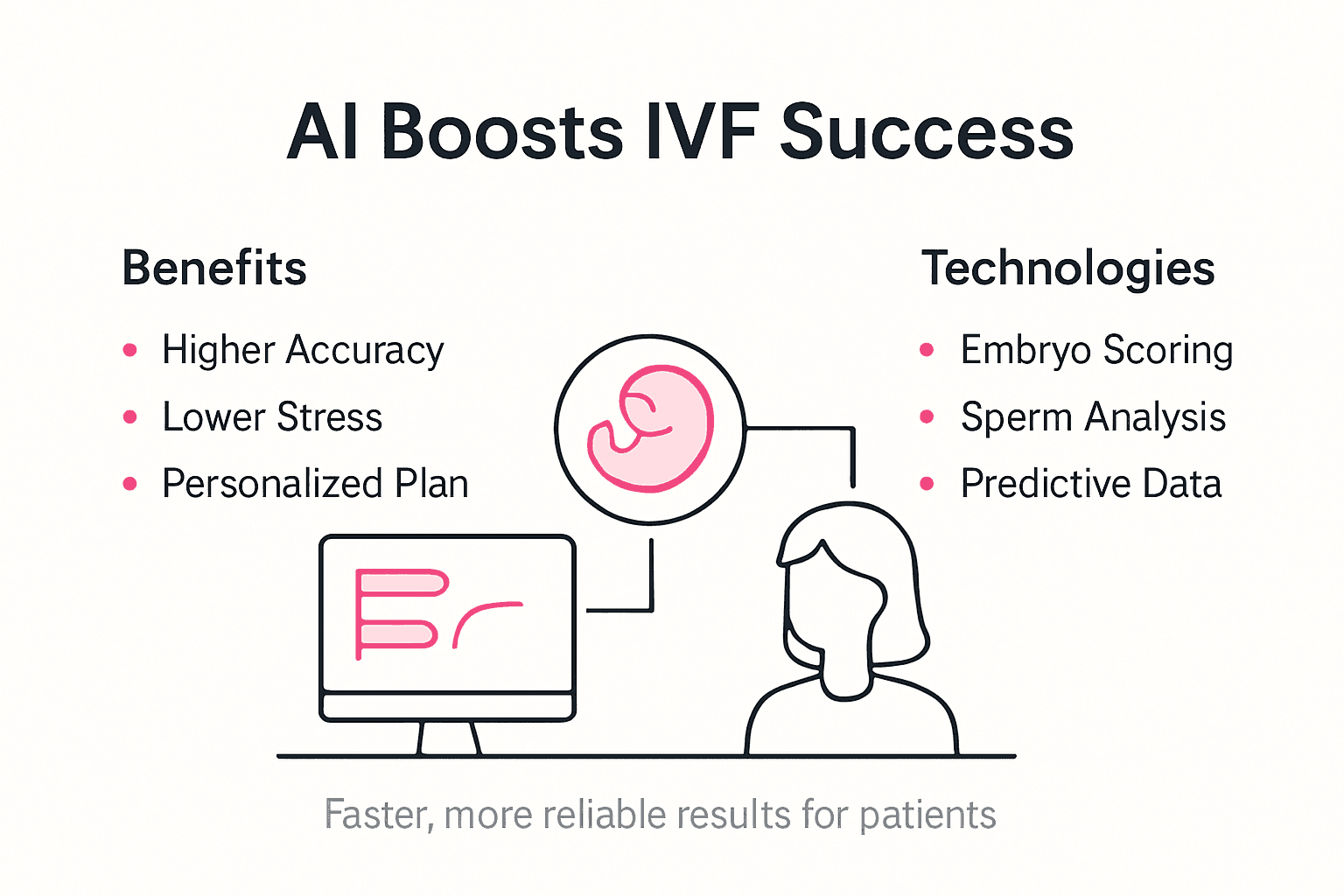
The economic impact of AI in fertility treatment extends beyond immediate procedure costs. Patients benefit from reduced emotional stress through more transparent, data-driven decision-making processes that provide clear insights into their reproductive potential. This approach transforms the traditional IVF experience from an unpredictable journey to a more controlled, financially sensible pathway.
Pro tip: Request a comprehensive cost-benefit analysis from your fertility specialist that outlines how AI technologies can potentially reduce your overall treatment expenses and emotional stress.
Real-World Success Rates and Patient Experiences
Advanced AI-driven fertility technologies have demonstrated remarkable improvements in clinical pregnancy outcomes, with groundbreaking studies revealing success rates climbing above 77%. These innovative approaches transform patient experiences by replacing subjective clinical decisions with data-driven, personalized treatment strategies that significantly enhance reproductive possibilities.
Key performance metrics highlighting AI’s impact include:
Clinical pregnancy rates exceeding traditional methods
More precise implantation predictions
Reduced invasive intervention requirements
Enhanced patient satisfaction through transparent processes
Comprehensive retrospective analyses involving nearly 19,000 IVF patients provide compelling evidence of AI’s transformative potential. By optimizing critical treatment windows like hormone trigger injection timing, these intelligent systems have demonstrated substantial improvements in live birth probabilities. Such data underscores AI’s ability to convert complex medical data into actionable insights that directly benefit patients.
While current research predominantly stems from single-center studies, the emerging patterns suggest a revolutionary shift in reproductive medicine. Patients now have access to more accurate, personalized fertility treatments that minimize uncertainty and maximize potential success, fundamentally reimagining the IVF journey from a process of hope to one of strategic, scientifically guided reproductive planning.
Compare traditional and AI-integrated IVF approaches:
Aspect | Traditional IVF | AI-Integrated IVF |
Embryo Evaluation | Manual, subjective grading | Automated, objective assessment |
Cost Management | Multiple cycles required | Streamlined, fewer treatments needed |
Stress Levels | Uncertain outcomes | Clearer data and expectations |
Success Rate | Typically below 60% | Frequently exceeds 77% |
Pro tip: Request detailed success rate documentation from your fertility specialist that specifically outlines their AI-driven technologies and corresponding clinical outcomes.
Discover How AI Transforms Your IVF Journey at Aurea Fertility
The article highlights the critical challenges many patients face during IVF: uncertainty, high costs, and subjective assessments that can impact success rates. If you are searching for a fertility clinic that directly addresses these pain points with cutting-edge solutions, Aurea Fertility offers precisely that. By integrating AI-powered technologies such as AI-guided stimulation, embryo scoring, and predictive analytics, we personalize your treatment plan to maximize success while reducing stress and expenses. This means fewer guesswork phases and more clear, data-driven decisions tailored to your unique profile.
Experience the future of fertility care where advanced machine learning algorithms and compassionate clinical oversight come together. Our AI-driven approach enhances embryo selection accuracy and sperm analysis precision helping you achieve better implantation rates and higher pregnancy success.

Take control of your fertility journey today by exploring how Aurea Fertility’s AI-integrated protocols can increase your IVF success chances. Visit Aurea Fertility to learn more about our personalized treatments and book your consultation. Don’t wait to benefit from innovations designed for women under 40 with good ovarian reserve who deserve the most efficient, supportive path to parenthood. See how AI can make the difference for you now at AI Integrated Protocols and start your transformation.
Frequently Asked Questions
How does AI improve embryo selection in IVF?
AI uses advanced grading algorithms to analyze the viability of embryos with higher predictive accuracy, leading to improved implantation success rates.
What are the benefits of predictive analytics in fertility treatment?
Predictive analytics allows clinicians to analyze intricate patient data, helping to develop personalized fertility plans that improve treatment outcomes by estimating success rates and identifying reproductive challenges in advance.
How can AI reduce costs associated with IVF?
AI streamlines treatment protocols and optimizes resource allocation, allowing for accurate predictions of egg maturity and reducing the number of unnecessary medical interventions, which can lower overall treatment costs.
What success rates can patients expect from AI-integrated IVF compared to traditional methods?
AI-integrated IVF approaches have demonstrated success rates exceeding 77%, significantly higher than the typical success rates of traditional IVF methods, which are often below 60%.
Recommended


Comments