
Why Fertility Treatments Fail: Causes and Solutions

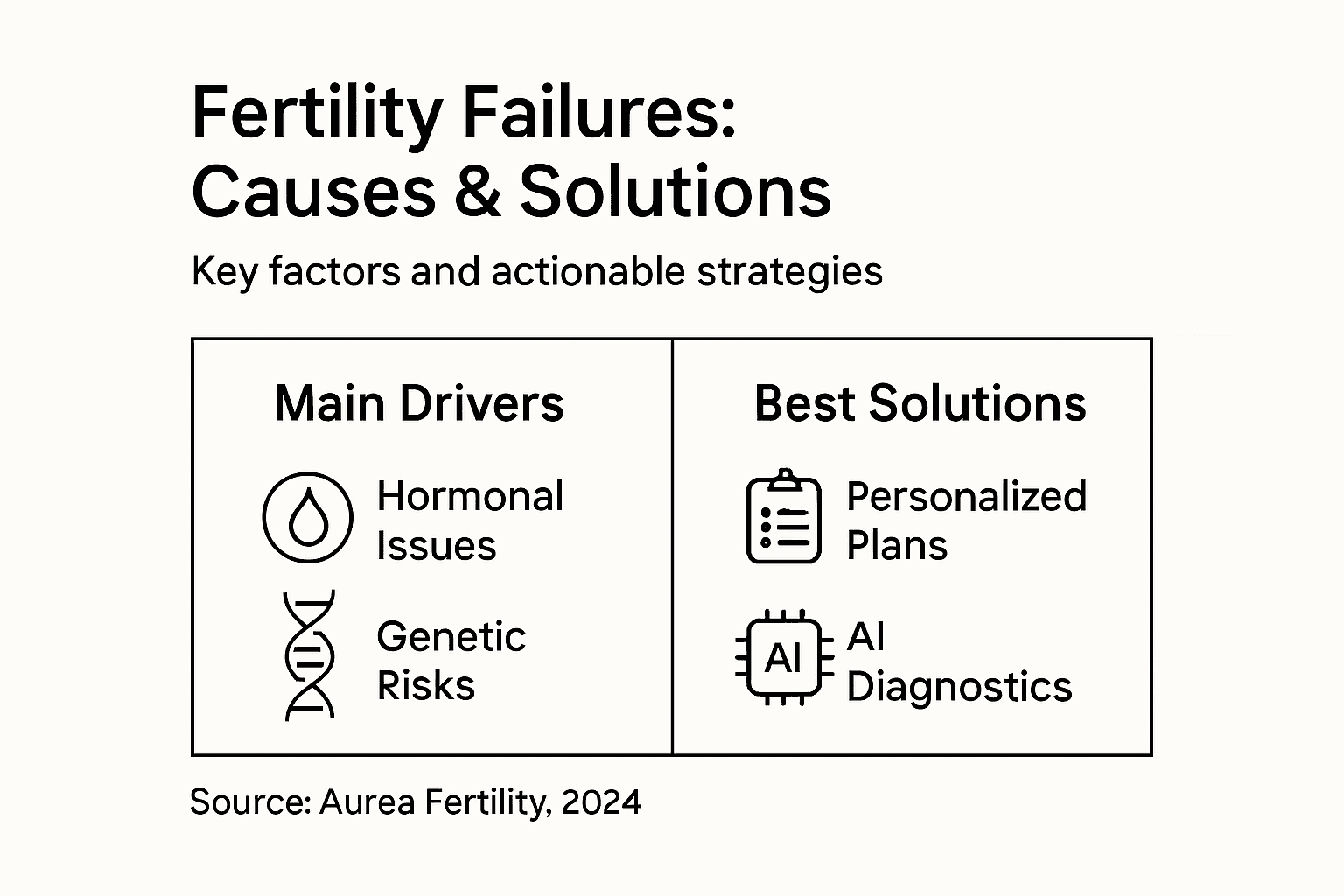
Bold new options are emerging for women under 40 with good ovarian reserve who want to make the most of their fertility journey. Rapid, AI-driven fertility treatments promise personalized solutions, but navigating the reasons these modern approaches might fail is just as important. With nearly 85% to 90% of infertility cases treated successfully using conventional methods, understanding how advanced technology, reproductive biology, and individual health factors shape outcomes helps you choose the tools and strategies that best support your path to parenthood.
Table of Contents
Key Takeaways
Point | Details |
Fertility Treatments Are Diverse | Various treatment methods exist, including medication, surgery, assisted reproductive technologies, genetic screening, and donor options, tailored to individual needs. |
Age Significantly Affects Success Rates | Women over 35 face lower fertility treatment success rates, emphasizing the importance of timely intervention. |
Technological Innovations Enhance Personalization | Artificial intelligence and advanced diagnostic tools are improving the accuracy and effectiveness of fertility treatments. |
Comprehensive Assessment is Essential | A thorough evaluation of medical history and lifestyle factors is critical in developing an effective fertility treatment plan. |
Fertility Treatments: Core Concepts Explained
Fertility treatments represent complex medical approaches designed to help individuals and couples struggling with reproductive challenges. Understanding reproductive biology involves recognizing intricate hormonal and physiological processes that influence conception.
Modern fertility treatments encompass a wide range of medical interventions targeted at addressing specific reproductive challenges. These treatments can be categorized into several primary approaches:
Medication-based treatments targeting hormonal regulation
Surgical interventions correcting structural reproductive issues
Assisted reproductive technologies (ART) like in-vitro fertilization
Advanced genetic screening techniques
Donor-based options including eggs, sperm, and embryo donation
Approximately 85% to 90% of infertility cases can be treated through conventional medical strategies. When standard treatments prove ineffective, more advanced techniques like surrogacy or comprehensive genetic screening become viable alternatives.
Here’s a quick comparison of fertility treatment types and their primary objectives:
Treatment Type | Focus Area | Typical Use Scenario |
Medication-based | Hormonal regulation | Treats ovulation disorders |
Surgical interventions | Structural correction | Repairs blocked or damaged tubes |
Assisted reproductive tech | Egg/sperm manipulation | Used for IVF or ICSI procedures |
Genetic screening | DNA analysis | Assesses risk for genetic diseases |
Donor-based options | Gamete/embryo replacement | Used when gamete quality is low |
The effectiveness of fertility treatments depends on multiple interconnected factors, including age, overall health, specific reproductive challenges, and precision of medical protocols. Technological advancements, particularly artificial intelligence and machine learning, are dramatically improving treatment personalization and success rates.
Fertility treatments are not one-size-fits-all but highly individualized medical interventions requiring comprehensive diagnostic assessment.
Pro tip: Consult multiple fertility specialists and request comprehensive diagnostic testing to develop the most personalized treatment strategy for your specific reproductive health profile.
Common Reasons Fertility Treatments Fail
Fertility treatments can fail due to multiple complex and interconnected factors. Underlying medical conditions significantly impact the success rates of reproductive interventions, with challenges emerging at various stages of conception.
The primary reasons for fertility treatment failure include:
Ovulation disorders such as Polycystic Ovary Syndrome (PCOS)
Fallopian tube damage preventing egg and sperm interaction
Sperm quality issues affecting fertilization potential
Age-related reproductive decline
Endometriosis and uterine structural complications
Genetic or chromosomal abnormalities
Hormonal imbalances disrupting reproductive processes
Age plays a critical role in fertility treatment outcomes. Women over 35 experience dramatically reduced success rates, with fertility potential declining exponentially with each passing year. Biological factors like egg quality, chromosomal integrity, and reproductive system functionality become increasingly challenging as women approach their late thirties and early forties.
Technological advancements are helping mitigate some of these challenges through precise diagnostic techniques that can identify and address specific reproductive obstacles. Artificial intelligence and advanced genetic screening are enabling more personalized and targeted treatment protocols.
Not all fertility challenges are straightforward, and individual patient experiences can vary significantly from standard statistical outcomes.
Pro tip: Request a comprehensive genetic and hormonal screening before beginning fertility treatments to develop the most targeted and personalized intervention strategy.
Patient-Specific Factors Impacting Success
Fertility treatment success is deeply personal and varies dramatically between individuals. ART success rates depend on a complex interplay of biological, medical, and lifestyle factors that uniquely influence each patient’s reproductive potential.
Key patient-specific factors that significantly impact fertility treatment outcomes include:
Chronological age and reproductive biological age
Previous pregnancy history
Duration of infertility
Specific reproductive health diagnoses
Ovarian reserve and egg quality
Male partner’s fertility parameters
Underlying medical conditions
Lifestyle and environmental factors
Women with specific reproductive challenges experience varying treatment success rates. Fertility treatment effectiveness differs substantially based on the underlying cause of infertility. For instance, patients with ovulation disorders might see higher success rates compared to those with severe fallopian tube damage or complex endometriosis.

The table below highlights key patient factors affecting fertility treatment success:
Patient Factor | Impact on Outcome | Notes |
Chronological age | Major influence on success | Success drops after age 35 |
Previous pregnancies | Indicator of reproductive health | Suggests underlying fertility status |
Ovarian reserve | Determines egg availability | Lower reserve reduces success |
Male fertility | Affects fertilization odds | Sperm quality is critical |
Personalized medical approaches are crucial in navigating these nuanced fertility challenges. Advanced diagnostic techniques now allow medical professionals to develop highly customized treatment protocols that account for individual genetic, hormonal, and physiological variations.
Individual fertility journeys are unique, and statistical averages cannot capture the complexity of personal reproductive experiences.
Pro tip: Maintain a comprehensive medical history and openly discuss all relevant health details with your fertility specialist to optimize your personalized treatment strategy.
How AI and Technology Address Challenges
Artificial intelligence is transforming fertility treatment by providing unprecedented insights and precision. AI platforms support clinical decision-making through advanced data analysis, helping clinicians develop more targeted and effective reproductive strategies.
Key technological innovations in fertility treatment include:
Predictive analytics for treatment success probability
Machine learning algorithms for embryo selection
Advanced genetic screening techniques
Real-time monitoring systems
Personalized treatment pathway generation
Comprehensive patient risk assessment
Automated diagnostic interpretation
Data-driven technologies now enable precise IVF success prediction by analyzing complex patient factors. These sophisticated tools can estimate live birth likelihood with remarkable accuracy, considering variables like age, medical history, previous treatments, and specific reproductive challenges.
Technological precision reduces human error and provides patients with more transparent, data-backed treatment recommendations. By integrating multiple data points, AI systems can identify subtle patterns that traditional diagnostic methods might overlook, potentially increasing overall fertility treatment success rates.
Technology transforms fertility treatment from a generalized approach to a highly personalized, scientifically optimized journey.
Pro tip: Request comprehensive AI-powered diagnostic reports and discuss how emerging technologies can be integrated into your specific fertility treatment plan.
Strategies for Improving Fertility Outcomes
Improving fertility outcomes requires a comprehensive, multifaceted approach that addresses complex medical and personal challenges. Clinical strategies focus on individualized care02246-0/fulltext) tailored to each patient’s unique reproductive health profile.
Key strategies for enhancing fertility treatment success include:
Early and comprehensive diagnostic screening
Personalized treatment protocol development
Lifestyle and nutritional optimization
Advanced genetic testing
Holistic stress management techniques
Targeted hormonal interventions
Regular reproductive health monitoring
Research-driven approaches emphasize prevention, early intervention, and addressing underlying reproductive health challenges. By integrating advanced diagnostic technologies, genetic screening, and personalized treatment pathways, clinicians can significantly improve the likelihood of successful fertility outcomes.
Technological innovations are transforming fertility treatment strategies, enabling more precise diagnoses, targeted interventions, and comprehensive patient support. Machine learning algorithms and advanced data analytics now allow for unprecedented levels of personalization in reproductive healthcare.
Successful fertility treatment is a collaborative journey between patients and medical professionals, requiring a holistic, data-driven approach.
Pro tip: Develop a comprehensive reproductive health strategy by maintaining detailed medical records, tracking lifestyle factors, and actively participating in collaborative discussions with your fertility specialist.
Overcome Fertility Treatment Challenges with Personalized AI-Driven Care
Understanding why fertility treatments fail is a crucial step in finding effective solutions. This article highlights common barriers like ovulation disorders, hormonal imbalances, and age-related decline. If you are facing these complex challenges, it is essential to access personalized medical strategies that address your unique reproductive health profile instead of one-size-fits-all approaches. Aurea Fertility understands the emotional toll infertility can take and combines cutting-edge artificial intelligence tools with compassionate care to transform your fertility journey.
Why choose Aurea Fertility?
AI-assisted diagnostics that pinpoint specific causes behind treatment failure
Rapid treatment pathways that minimize waiting times and reduce unnecessary procedures
Personalized protocols for egg freezing, embryo scoring, and male fertility testing
24/7 patient support to guide you through every step with clear communication
Do not let uncertainty delay your path to parenthood. Discover how Aurea Fertility’s technology-driven solutions can elevate your chances of success with a customized fertility plan tailored just for you. Take control of your fertility journey today by exploring our advanced treatment options and scheduling a consult with experts who prioritize speed, affordability, and personalized care.
Frequently Asked Questions
What are the common reasons for fertility treatment failure?
Fertility treatment failures can result from various issues including, ovulation disorders, fallopian tube damage, sperm quality issues, age-related declines, endometriosis, hormonal imbalances, and genetic abnormalities.
How does age impact the success of fertility treatments?
Age significantly affects fertility treatment outcomes, especially for women over 35, as fertility potential decreases sharply due to factors like egg quality and reproductive system functionality.
What steps can be taken to improve the success rates of fertility treatments?
To enhance success rates, consider early and comprehensive diagnostic screening, personalized treatment plans, lifestyle optimization, and advanced genetic testing, alongside regular monitoring of reproductive health.
How can artificial intelligence improve fertility treatment outcomes?
Artificial intelligence helps in fertility treatments by providing predictive analytics, embryo selection algorithms, and real-time monitoring, which allow for personalized treatment pathways and increases the likelihood of successful outcomes.
Recommended


Comments