
Role of Data in Fertility Medicine: Enhancing Success Rates
- Jan 26
- 14 min read

Feeling frustrated by fertility treatments that seem to offer more waiting than real answers is all too common. Advances in AI-powered fertility medicine now allow clinics to translate your unique data—everything from hormone patterns to embryo characteristics—into precise, rapid decisions tailored for your body. For women under 40 with good ovarian reserve, this means shorter timelines and more cost-effective care as technology personalizes every step of your journey. Discover how data-driven fertility medicine is transforming uncertainty into real progress with global potential.
Table of Contents
Key Takeaways
Point | Details |
Data-Driven Customization | Data in fertility medicine tailors treatment plans based on individual patient metrics, improving outcomes compared to standard protocols. |
AI Utilization | AI transforms decision-making by analyzing vast datasets, enabling predictive insights for personalized treatment without relying solely on clinician intuition. |
Real-Time Monitoring | Continuous data tracking allows for immediate adjustments to treatment protocols, enhancing efficiency and decreasing overall treatment timelines. |
Transparency and Consent | Patients should inquire about data usage, privacy policies, and consent options to ensure informed participation in their treatment journey. |
Defining Data Use in Fertility Medicine
Data in fertility medicine refers to the systematic collection, analysis, and application of patient information to guide clinical decisions and optimize treatment outcomes. Unlike traditional fertility care, which relies heavily on generalized protocols and provider experience, data-driven fertility medicine transforms individual patient characteristics into actionable insights that shape personalized treatment plans. This means your age, ovarian reserve metrics, hormone levels, embryo development patterns, and even lifestyle factors become quantifiable inputs that inform whether you proceed with certain procedures, when you trigger egg retrieval, or which embryos offer the highest potential for success.
The practical implementation of data in fertility medicine encompasses several interconnected elements. Digital fertility tracking tools now complement clinical assessments by collecting granular information about your cycle patterns, response to medications, and embryo characteristics. This data integration creates what researchers call datafication in reproductive health, where traditional fertility knowledge becomes augmented by algorithmic analysis. For you specifically, this means continuous monitoring systems can detect subtle changes in your response to stimulation protocols, allowing your clinic to adjust medication doses in real time rather than waiting for scheduled check-in appointments. The transformation accelerates your treatment timeline from the typical 3-4 months down to roughly 2 weeks by eliminating guesswork and unnecessary repeat procedures.
What makes data particularly valuable in your situation is how it addresses the core challenge of fertility medicine: uncertainty. Without comprehensive data analysis, clinicians operate with incomplete information about your individual response patterns. With it, predictive algorithms can forecast egg quality, fertilization likelihood, and implantation potential based on thousands of previous cases combined with your specific clinical profile. How AI increases success rates becomes evident when data reveals which embryos have the morphological characteristics most strongly associated with pregnancy in patients with profiles similar to yours. You’re not just receiving “standard protocol” treatment; you’re receiving treatment customized to data that describes you uniquely.
Pro tip: Ask your clinic specifically what data points they collect at each stage and how that information directly influences your treatment adjustments, since transparency about data usage helps you understand why certain decisions differ from what you might read in general fertility forums.
Types of Data in Reproductive Treatments
Fertility medicine generates multiple categories of data that, when integrated together, paint a complete picture of your fertility status and treatment response. These data streams fall into three primary buckets: clinical data, biological data, and behavioral data. Clinical data includes your age, medical history, previous pregnancy outcomes, and baseline hormone levels measured at the start of your cycle. Biological data encompasses embryo characteristics like cell count, fragmentation patterns, and morphology grades, plus genetic information if you choose embryo genetic testing. Behavioral data tracks how your body responds to medications over time, including follicle growth rates, estrogen production curves, and egg retrieval yields across different dosing protocols.
What makes this categorization crucial for you is that each data type serves a different purpose in optimizing your treatment. Patient demographics and treatment outcomes collected across thousands of cycles reveal which characteristics predict success in women with profiles similar to yours. Your clinic doesn’t just record that you responded to a certain medication dose; they track the relationship between that dose and your specific follicle development pattern, then compare it against historical data from other women your age with comparable ovarian reserve. This comparative analysis identifies whether your response is optimal, suboptimal, or in need of protocol adjustment. The result is personalized dosing that maximizes egg production while minimizing overstimulation risk.
Biological data deserves special attention because it directly impacts your most critical decisions. Embryo morphology grades tell you which embryos have the architectural characteristics most strongly associated with implantation success. When this morphological data combines with multi-omics information from genetic testing, your clinic gains unprecedented insight into embryo viability. You might have eight embryos that all look visually similar under the microscope, but genetic screening reveals that only three actually have chromosomal integrity likely to result in pregnancy. Without this layered data integration, you might transfer an embryo with high morphology grade but chromosomal abnormalities, wasting a cycle. With it, your selection becomes evidence based rather than appearance based.
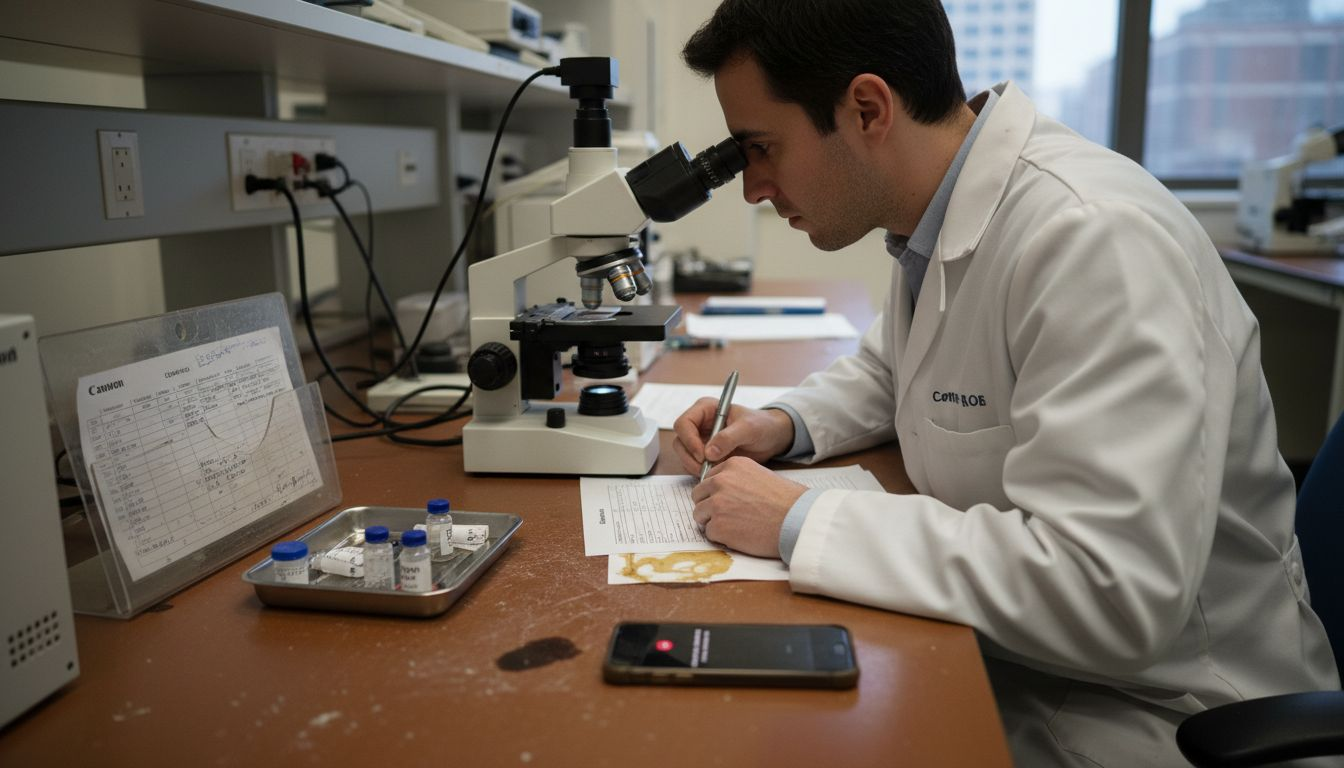
Behavioral and response data matter equally because they shape your next cycle. If your first stimulation cycle produced fewer eggs than expected given your AMH levels, clinicians analyze whether this reflected insufficient medication response, medication sensitivity, or procedural factors. They document egg maturity rates, fertilization percentages, and blastulation success. This longitudinal tracking identifies patterns that generic fertility protocols miss. You’re not repeating the exact same protocol as last time simply because it’s standard; you’re repeating a customized version informed by data showing how your biology specifically reacted.
Pro tip: Request a detailed data summary after each appointment that shows your specific metrics compared to age matched benchmarks, since understanding your individual data points helps you recognize which treatment adjustments address your unique response pattern.
Here’s a comparison of key data types used in fertility treatments and their roles:
Data Type | Main Examples | How It Informs Treatment |
Clinical Data | Age, medical history, hormone tests | Sets baseline protocols and risk factors |
Biological Data | Embryo morphology, genetics | Guides embryo selection and viability |
Behavioral Data | Dose response, follicle growth | Adjusts medication and cycle timing |
How AI Transforms Fertility Decisions
Artificial intelligence fundamentally changes fertility decision-making by converting raw data into actionable predictions that guide you toward the treatments most likely to succeed. Rather than relying on clinical judgment alone, AI algorithms analyze thousands of previous patient cycles to identify patterns invisible to the human eye. When your clinic uses machine learning models that predict IVF outcomes, they’re not guessing whether you’ll respond well to a specific medication dose or which embryo has the best implantation potential. They’re making recommendations backed by statistical analysis of how women with your exact profile responded in similar situations. This shift from intuition to evidence-based pattern recognition directly accelerates your treatment timeline and improves your odds of success.
The transformation starts at the very beginning of your fertility journey. AI systems analyze your baseline hormone levels, age, ovarian reserve markers, and medical history to predict your optimal stimulation protocol before you ever receive your first injection. Traditional clinics might start all women your age on a standard dose, then adjust based on how you respond over several days. AI-driven clinics forecast your response within hours of receiving your initial lab work, allowing them to customize your protocol from day one. This predictive capability reduces the number of monitoring appointments you need and eliminates the cycle delays that come from starting with a suboptimal dose. You move faster because the system learned from thousands of similar cases rather than learning from you trial and error.
Embryo selection represents where AI’s decision-making power becomes most transformative for your outcome. Artificial intelligence in assisted reproductive technologies enables more precise and objective embryo grading than morphology assessment alone. An embryologist might visually score an embryo as a “grade B” based on cell symmetry and fragmentation patterns, but AI analyzes hundreds of morphological features simultaneously, identifying subtle characteristics that predict implantation success. Two embryos might receive the same morphology grade from a human observer, yet AI scoring reveals that one has a 62 percent implantation probability while the other has only 38 percent. You’re not making embryo transfer decisions on incomplete information anymore; you’re making them on comprehensive, quantitative predictions of which embryo gives you the highest realistic chance of pregnancy.
What makes these AI-driven decisions particularly valuable for you is their consistency and speed. Technology integrating AI with gynecological expertise removes subjective variation that can occur when different clinicians review the same data. One provider might interpret your estrogen curve conservatively and recommend retrieval on day 11, while another might recommend day 12 based on the same numbers. AI removes this ambiguity by applying consistent criteria across every decision. This means your care pathway doesn’t depend on which clinician reviews your case on a particular day. More importantly, these AI systems operate continuously, allowing your clinic to make real time adjustments to your protocol rather than waiting for scheduled appointments. If your follicle development deviates from predicted patterns, the system flags it immediately, enabling intervention before a cycle becomes compromised.
Pro tip: Ask your clinic specifically which AI systems they use for embryo scoring and treatment predictions, and request that they show you your individual AI scores alongside traditional morphology grades so you understand the quantitative basis for their transfer recommendations.
Below is a summary of how AI transforms and improves each stage of fertility care:
Fertility Stage | Traditional Approach | AI-Driven Approach |
Protocol Selection | Based on clinician experience | Predictive analysis from data |
Monitoring Response | Scheduled appointments | Real-time tracking and alerts |
Embryo Selection | Morphology grades by expert | Quantitative AI probability score |
Timeline | Weeks to adapt treatment | Days with rapid adjustments |
Personalized Treatment Pathways and Outcomes
Personalized treatment pathways represent the logical conclusion of data-driven fertility medicine: every decision about your care is tailored specifically to your biology, not to population averages. Rather than following a one-size-fits-all protocol, your treatment plan emerges from analysis of your individual hormone response, ovarian reserve characteristics, embryo development patterns, and medical history. This customization begins before your first medication injection and continues through every stage of your cycle. AI-driven predictive models integrated with clinical expertise identify which stimulation dose will maximize your egg production without triggering overstimulation, when precisely to trigger final egg maturation, and which embryos deserve transfer based on your specific implantation probability. The outcome is treatment that moves at your biological pace rather than a predetermined schedule, dramatically reducing both treatment duration and emotional stress.
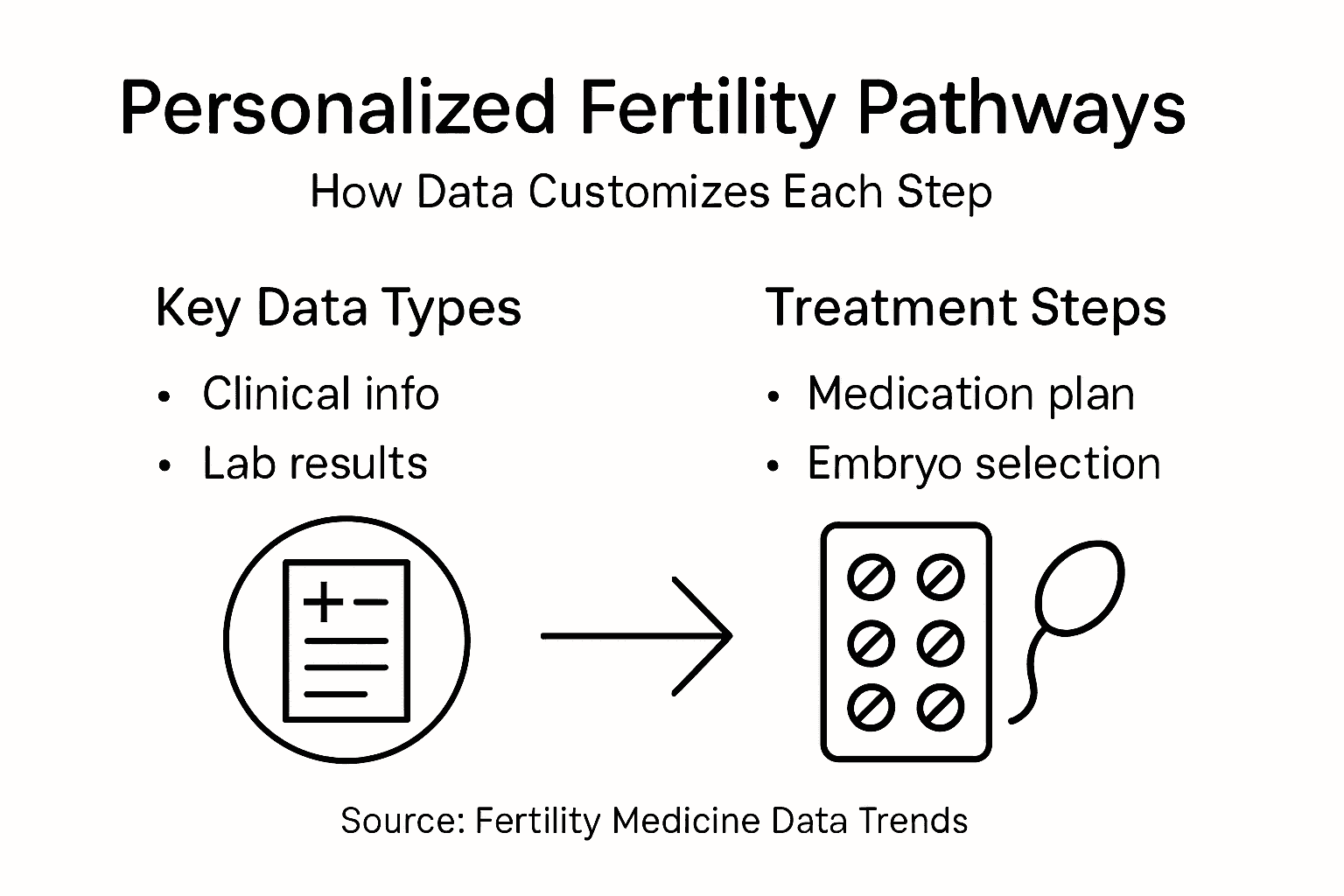
What makes personalized pathways transformative for your outcomes is their responsiveness to real-time data. Your clinic isn’t committed to a fixed protocol regardless of how your body responds. Instead, continuous monitoring reveals whether your follicles are developing faster or slower than predicted, whether your estrogen levels are climbing appropriately, and whether your embryos are progressing at normal rates. If your data deviates from expected patterns, your protocol adjusts immediately. A woman with slower follicle development might extend her stimulation by one day while another woman with accelerated response moves to retrieval ahead of schedule. Both receive optimized timing because the system responds to individual biology rather than applying uniform timing to every patient. This responsiveness directly improves your egg quality and embryo development because you’re not over-stimulated or under-stimulated relative to your specific needs.
The impact on embryo selection and transfer decisions becomes particularly pronounced with personalized approaches. Your clinic analyzes which embryo characteristics predict implantation success in women with your exact age, ovarian reserve profile, and medical background. A 35-year-old woman with excellent ovarian reserve might have implantation success with embryos that would be considered marginal for a 42-year-old woman with diminished reserve. Personalized data analysis recognizes these differences and recommends transfer strategies aligned with your individual probabilities. You’re not competing against population statistics anymore; you’re making decisions based on evidence specific to patients like you. This precision explains why personalized protocols achieve higher success rates with fewer transfer cycles compared to standard approaches.
When you combine personalized pathways with evidence-based fertility literacy and patient engagement, you gain agency over your reproductive decisions. Understanding why your clinic recommends a specific medication dose, why they selected a particular embryo for transfer, or why they adjusted your protocol timing empowers you to participate meaningfully in your care. You’re not simply following orders; you’re informed partner in a data-driven process designed specifically for your fertility profile. This engagement improves adherence to protocols, reduces anxiety about treatment choices, and strengthens your confidence in outcome expectations. Combined with faster treatment timelines and higher success rates, personalized pathways transform fertility from a months-long ordeal into a focused, efficient journey aligned with your biology.
Pro tip: Before starting treatment, ask your clinic to show you a sample personalized protocol report for someone with a profile similar to yours, including what data points they analyze and how those data directly influence specific protocol decisions for your individual case.
Risks, Ethical Issues, and Data Privacy
The benefits of data-driven fertility medicine come with genuine responsibilities around how your personal information is collected, stored, and used. Your fertility data is deeply intimate, revealing not just medical information but also your reproductive timeline, genetic characteristics, and sometimes information about partners or donors. Ethical concerns in digital fertility technologies include surveillance risks, questions about data ownership, and the possibility that your information could be used in ways you didn’t explicitly consent to. When you share cycle data with a fertility app or clinic, you’re creating a digital record of your reproductive health that could potentially be accessed by employers, insurers, or other third parties if security is breached or data is sold. This isn’t theoretical concern; it’s a real consideration that deserves your attention before you hand over sensitive information.
The regulatory landscape around fertility data remains underdeveloped compared to the rapid pace of technological advancement. AI integration in reproductive medicine raises challenges regarding patient consent, data privacy standards, and the absence of clear legal guidelines for how fertility data should be handled. Different clinics operate under different data protection standards, meaning your experience at one clinic might offer stronger privacy safeguards than another. Some clinics may use your anonymized data to train their AI algorithms, improving their systems for future patients but potentially giving you limited control over how your individual case contributes to that development. Others might sell aggregated fertility data to pharmaceutical companies or research institutions. You need explicit clarity about what happens to your data beyond your immediate treatment. Ask whether your clinic shares data with third parties, whether data sharing is optional or mandatory, and what specific protections exist if their systems are compromised.
Consent becomes ethically problematic when the scope of data usage expands beyond what you initially agreed to. You might consent to your clinic using your data to personalize your own treatment protocol but feel uncomfortable with your data training AI systems used globally or being linked with your genetic information for research purposes you didn’t anticipate. The challenge is that fertility data becomes more valuable when combined with other datasets, creating pressure to link your reproductive health information with your genetic records, lifestyle data, or family medical history. This linkage can reveal insights about infertility risk, but it also expands the scope of your digital footprint in ways that feel invasive. Reputable clinics should allow you to opt out of data sharing entirely without penalizing your care, even if this means you don’t benefit from the most advanced AI personalization.
Protecting yourself requires asking specific questions before treatment begins. Understand exactly which data your clinic collects, how long they retain it, who has access to it, and what explicit safeguards exist against breach or misuse. Request that your clinic provide their data privacy policy in plain language rather than corporate legalese. Ask whether you can opt out of any data sharing without affecting your clinical care. Verify that your clinic complies with relevant privacy regulations in your country or region, whether that’s HIPAA in the United States, GDPR in Europe, or equivalent standards elsewhere. If your clinic seems evasive about data practices or can’t articulate clear privacy protections, that’s a warning signal worth taking seriously.
Pro tip: Before signing consent forms, request your clinic’s complete data privacy policy and ask them to highlight in writing which data is shared with third parties, who owns your data after treatment ends, and how long they retain your genetic or embryo information.
Cost, Efficiency, and Patient Experience
The financial reality of fertility treatment weighs heavily on your decision-making, and data-driven approaches address this directly by reducing both the time and money you spend on unsuccessful cycles. Traditional fertility clinics operate on extended timelines because they follow standard protocols regardless of individual response, often requiring multiple monitoring appointments over weeks before making treatment adjustments. This stretched-out process means repeated ultrasounds, blood tests, and office visits that accumulate costs even before you reach egg retrieval. Data-driven clinics compress this timeline dramatically by predicting your optimal protocol from your initial labs, allowing you to move from consultation to retrieval in approximately two weeks instead of the typical six to eight weeks. This acceleration alone reduces monitoring costs substantially while also lowering your medication expenses since you’re not cycling through multiple protocol adjustments.
The cost savings extend beyond reduced appointment frequency. When digital fertility tracking tools enhance treatment precision, your clinic minimizes unnecessary procedures and medications that don’t directly serve your individual response pattern. Rather than prescribing the standard stimulation dose to every woman your age, data analysis identifies the specific dose most likely to work for you, reducing the risk of under-stimulation that requires protocol restarts or over-stimulation that requires cycle cancellation. You’re not paying for failed cycles caused by suboptimal protocols because the system anticipated your needs before treatment began. This precision-based approach also reduces the emotional and physical toll of multiple cycles, since personalized protocols achieve success more quickly on average. The patient experience improves measurably when you’re not cycling repeatedly or facing unexpected protocol changes mid-cycle.
Data collection itself enhances clinic efficiency in ways that ultimately benefit your experience. Service efficiency and resource allocation informed by fertility data enables clinics to schedule appointments more strategically, stock medications more accurately, and allocate embryologist time more effectively. When a clinic understands its population-level data about egg retrieval timing, embryo development rates, and transfer success patterns, they can organize their operations around actual patient needs rather than theoretical schedules. This operational efficiency translates to shorter wait times for appointments, faster result turnarounds, and less bureaucratic friction in your treatment journey. You spend less time waiting in offices, receive your results more quickly, and experience fewer scheduling conflicts that force you to delay treatment.
The patient experience improves further when data transparency becomes standard practice. Understanding why your clinic recommends a specific protocol, how your individual metrics compare to relevant benchmarks, and what your realistic success odds are removes uncertainty that amplifies stress. You’re not wondering whether your clinic made the right decision or whether you’re getting appropriate care; you’re seeing the data-driven reasoning behind each recommendation. This transparency builds confidence in your treatment plan and reduces the anxiety that often accompanies fertility treatment. Combined with faster timelines, reduced appointment burden, and higher success rates per cycle, data-driven approaches transform your fertility experience from months of uncertainty and expense into a focused, efficient journey with clear endpoints and realistic outcome expectations.
Pro tip: Request a detailed cost comparison from your clinic showing what a typical patient pays for treatment under their standard protocol versus their data-driven personalized approach, including medication costs, monitoring appointments, and average number of cycles to success.
Experience Data-Driven Fertility Care Tailored to You
The article highlights how uncertainty in fertility treatment can hold you back and how personalized data integration offers a clearer path to success. If you are seeking a fertility solution that values your unique biology, responds to your real-time data, and minimizes guesswork, Aurea Fertility is designed for your needs. By leveraging artificial intelligence to analyze your clinical, biological, and behavioral data, we create tailored protocols that optimize medication doses, embryo selection, and treatment timing. This means you can avoid the emotional and financial stress caused by generic approaches and experience faster, more effective fertility care.
Don’t wait months for answers when treatment can be accelerated and customized for you. Discover how our AI-powered tools and 24/7 patient support work together to reduce treatment time to around two weeks while improving your chances of success. Start your personalized fertility journey with Aurea Fertility today and gain confidence in every decision along the way. Visit our main site to learn more about our AI-driven protocols and embryo monitoring tailored to your profile and see how data transforms your treatment outcomes.
Frequently Asked Questions
What types of data are used in fertility medicine?
Data in fertility medicine can be categorized into three primary types: clinical data (such as age, medical history, and hormone levels), biological data (including embryo characteristics and genetic information), and behavioral data (tracking responses to medications and treatment protocols).
How does artificial intelligence enhance fertility treatment outcomes?
Artificial intelligence enhances fertility treatment by analyzing large datasets from previous patient cycles to predict outcomes, optimize medication protocols, and improve embryo selection, leading to more personalized treatment and higher success rates.
Why is personalized treatment important in fertility medicine?
Personalized treatment is crucial because it tailors fertility protocols to an individual’s unique biological responses and medical history, reducing the guesswork involved in traditional methods and increasing the chances of successful outcomes.
What role does data privacy play in fertility treatments?
Data privacy is vital in fertility treatments as it ensures that sensitive personal information is handled securely and ethically. Patients should inquire about data usage, consent, and security measures before undergoing treatment.
Recommended
Comments