
Fertility Treatment Pathway: Speeding Up Parenthood
- 6 days ago
- 14 min read

Weighing your fertility options when you have a strong ovarian reserve and time on your side can still feel overwhelming, especially as uncertainty and cost pressures mount. Across different countries, strict regulations and unequal access complicate the treatment journey for many women. AI-driven personalization now promises a faster, less stressful pathway by turning your history and test results into a tailored protocol—ensuring your plan is as unique as your story and designed to reduce wasted time and expense. Bold new tools bring hope to the forefront of your fertility care.
Table of Contents
Key Takeaways
Point | Details |
Personalized Fertility Pathway | A fertility treatment pathway is tailored to individual circumstances, ensuring effective and efficient care. |
Importance of Speed | Timely intervention is crucial, especially for those under 40 with good ovarian reserve; an optimized pathway minimizes time to pregnancy. |
Role of AI in Treatment | AI enhances personalization in fertility treatments, improving diagnosis, medication protocols, and embryo selection, leading to higher success rates. |
Need for Support Systems | Emotional and psychological support is essential during fertility treatment, impacting both mental well-being and treatment outcomes. |
Defining the Fertility Treatment Pathway
A fertility treatment pathway is your personalized roadmap from initial diagnosis through successful pregnancy. It’s not one-size-fits-all; it’s tailored to your specific situation, age, ovarian reserve, and medical history.
Think of it like a GPS for your fertility journey. Rather than wandering through endless tests and treatments, you follow a clear plan designed specifically for you. This is where speed meets precision.
The World Health Organization recognizes that infertility treatment pathways require timely, evidence-based care integrated into health strategies. This means your pathway should move you forward efficiently while following proven medical protocols.
What Makes Your Pathway Unique
Your fertility pathway differs from someone else’s based on several factors:
Your current age and ovarian reserve status
Your specific diagnosis (if any)
Previous fertility treatments you’ve tried
Your lifestyle, goals, and timeline
Access to advanced technologies like AI-assisted diagnostics
Without personalization, many women waste months repeating unnecessary tests or following generic protocols that don’t match their needs.
Your fertility pathway should be as unique as your fingerprint, not a photocopy of someone else’s treatment plan.
The Three Core Stages
Most fertility pathways follow a structured progression:
Assessment phase – Understand your fertility status through targeted testing
Treatment phase – Execute your personalized protocol with precision monitoring
Support phase – Emotional, medical, and logistical guidance throughout your journey
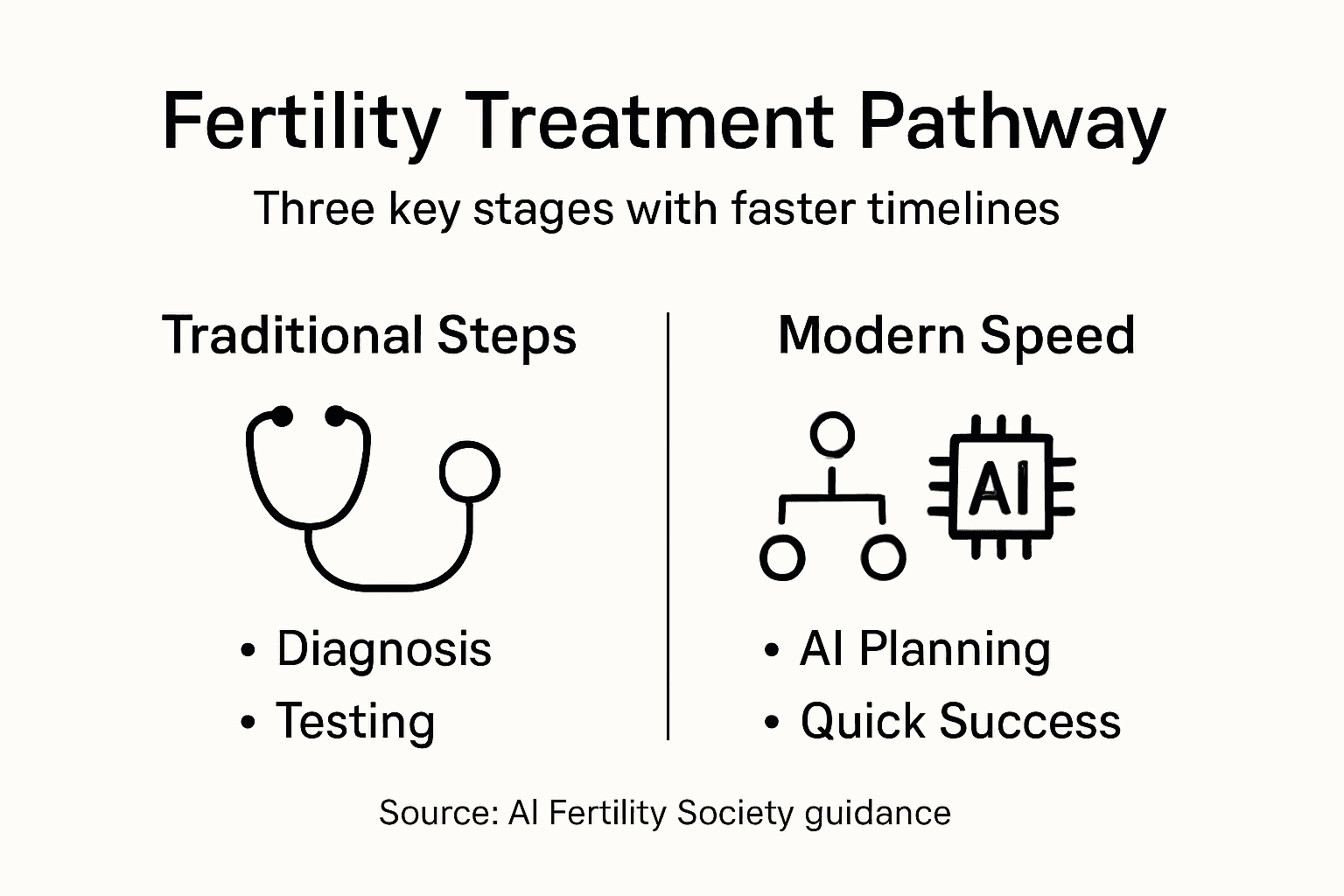
The traditional timeline for these stages can stretch 3-6 months or longer. Modern AI-driven approaches compress this to 2-3 weeks by eliminating redundant testing and optimizing each step.
Why Speed Matters for Your Age Group
If you’re under 40 with good ovarian reserve, time is your asset—not your enemy. Every month counts when biological factors are in your favor. A streamlined pathway that respects this window accelerates your timeline without sacrificing care quality.
Delays in treatment often come from outdated protocols, communication gaps, or unnecessary procedures. When your pathway is optimized, you move directly toward pregnancy rather than spinning in diagnostic loops.
How Technology Transforms Your Pathway
AI and advanced diagnostics change what’s possible in your treatment journey:
Predictive analytics identify your most viable eggs before transfer
Machine learning algorithms optimize medication protocols for your body
Real-time embryo monitoring replaces static snapshot assessments
Automated scheduling eliminates back-and-forth coordination delays
These tools work together to create a fertility protocol transformed by AI, ensuring every decision is data-driven and personalized to maximize your success.
Your pathway is not just a sequence of appointments. It’s an intelligent system designed to deliver results efficiently while minimizing stress and cost.

Pro tip: Ask your fertility clinic to show you the complete timeline for your pathway upfront—including all testing dates, treatment cycles, and decision points. Transparency about timing helps you plan emotionally and logistically for what’s ahead.
Major Types of Fertility Treatments
Fertility treatments range from simple medication to advanced laboratory procedures. Your specific treatment depends on your diagnosis, age, ovarian reserve, and what’s worked (or hasn’t) in the past.
Not every woman needs IVF. Many succeed with less invasive options. The key is matching the right treatment to your situation—fast.
Medication-Based Treatments
Ovulation-inducing medications are often the first step when irregular or absent ovulation is the issue. These drugs stimulate your ovaries to produce eggs.
Common medications include:
Clomiphene citrate (oral medication that triggers ovulation)
Gonadotropins (injectable hormones that directly stimulate egg production)
Letrozole (an alternative oral medication)
These work best when your reproductive anatomy is normal and ovulation is the only barrier. Treatment typically takes 1-3 months to see results. Success rates vary, but many women ovulate successfully on their first or second cycle.
Intrauterine Insemination (IUI)
IUI places prepared sperm directly into your uterus during ovulation, bypassing cervical barriers and reducing the distance sperm must travel.
IUI works best for:
Unexplained infertility
Mild male factor issues
Cervical factor problems
Same-sex couples or single women using donor sperm
Evidence-based treatment comparisons show IUI combined with ovulation stimulation increases success rates compared to natural cycle IUI. The procedure itself takes minutes. Timing is critical—IUI must occur within 24-36 hours of ovulation.
In Vitro Fertilization (IVF)
IVF involves retrieving eggs, fertilizing them in a lab, and transferring resulting embryos into your uterus. It’s the most comprehensive fertility treatment available.
IVF is recommended for:
Blocked or damaged fallopian tubes
Severe male factor infertility
Endometriosis
Repeated IUI failures
Advanced maternal age with diminished ovarian reserve
Unexplained infertility after other treatments fail
Traditional IVF takes 4-6 weeks per cycle. AI-enhanced IVF protocols at advanced clinics compress this to 2-3 weeks by optimizing medication timing and embryo selection.
The most effective treatment isn’t always the most invasive—it’s the one matched precisely to your specific fertility challenge.
Surgical Interventions
When structural problems block fertility, surgery may be necessary. Common procedures include:
Laparoscopy – diagnoses and treats endometriosis, adhesions, or blocked tubes
Hysteroscopy – removes polyps or corrects uterine abnormalities
Surgical sperm retrieval – extracts sperm from the testicles when ejaculation is impossible
Surgery resolves specific anatomical barriers but doesn’t address hormonal or age-related infertility.
Donor Options and Assisted Reproductive Technologies
When your own eggs or sperm aren’t viable, donor options including egg, sperm, and embryo donation expand possibilities. Egg donation helps women with poor ovarian reserve or genetic concerns. Sperm donation addresses male factor infertility. Embryo donation provides an option for couples with both egg and sperm issues.
These approaches require careful legal and emotional preparation but offer high success rates because donor material is typically from younger, fertile individuals.
Here’s a comparison of major fertility treatment types to clarify how they differ:
Treatment Type | Typical Candidates | Process Length | Invasiveness Level |
Ovulation Medications | Women with ovulation issues | 1-3 months | Minimal (oral/injection) |
IUI | Mild male factor, unexplained cases | 1 cycle, minutes | Low (intrauterine) |
IVF | Tubal, severe male, advanced age | 2-6 weeks per cycle | High (egg retrieval, labs) |
Surgery | Structural/anatomical challenges | 1 procedure, recovery | Moderate to high |
Donor ART | Nonviable eggs/sperm, genetic issues | 2-6 weeks per cycle | High, with added steps |
Matching Treatment to Your Timeline
Your age and ovarian reserve determine urgency. Under 40 with good reserve? You have flexibility to try simpler treatments first. Poor reserve? Moving directly to IVF often makes sense to capitalize on remaining egg quality.
Speed matters, but so does avoiding unnecessary procedures. Your pathway should progress logically, not waste months on unlikely options.
Pro tip: Before starting any treatment, ask your clinic to explain why they’re recommending this specific option over others. A personalized explanation—tied to your diagnosis and age—indicates they’ve tailored care rather than following a generic protocol.
AI-Driven Personalization and Process Steps
Traditional fertility clinics follow standard protocols for everyone. AI-driven clinics analyze your unique biology and customize every step of your treatment. This personalization is what compresses months into weeks.
Artificial intelligence examines your age, ovarian reserve, hormone levels, previous responses to medication, and embryo quality data. It then recommends the exact protocol most likely to succeed for you—not for an average patient, but for you specifically.
How AI Analyzes Your Data
AI systems integrate multiple data streams to build a complete picture of your fertility profile:
Baseline hormone levels and ovarian reserve markers
Response patterns to previous medications (if applicable)
Embryo development rates and genetic screening results
Lifestyle factors affecting egg and sperm quality
Timing optimization for medication administration
Advanced AI systems optimize assisted reproduction protocols01154-3/fulltext) by analyzing these variables simultaneously. Machine learning identifies patterns human clinicians might miss, improving both efficiency and success rates.
This analysis happens quickly. What takes traditional clinics weeks to evaluate takes AI hours.
Personalized Protocol Recommendations
Every woman responds differently to stimulation medications. Some need aggressive doses; others thrive on minimal stimulation. AI predicts your optimal dosage and timing before you start injecting.
Protocol personalization includes:
Medication dosage tailored to your hormone baseline and ovarian reserve
Stimulation duration predicted based on your egg development patterns
Trigger timing optimized for your unique response curve
Transfer timing aligned with your endometrial readiness
Generic protocols waste cycles on incorrect dosages. Personalized protocols match your physiology from day one.
Real-Time Embryo Monitoring and Selection
Traditional embryo assessment happens at fixed checkpoints—day 3, day 5, day 6. You get a static snapshot. AI monitors embryo development continuously, capturing subtle developmental patterns that predict viability more accurately.
AI doesn’t replace embryologist judgment—it enhances it by detecting growth patterns invisible to periodic observations.
AI-enhanced embryo scoring considers:
Morphology (cell symmetry and fragmentation)
Development kinetics (timing of cell divisions)
Genetic potential (when combined with PGT-A data)
Implantation probability (based on historical data)
This precision means you transfer the highest-potential embryo, increasing success rates while reducing unnecessary transfers.
Streamlined Treatment Timeline
AI accelerates your pathway by eliminating decision delays and redundant testing:
Initial assessment – Complete fertility evaluation in 3-5 days
Protocol design – AI generates personalized plan within 24 hours
Stimulation – Optimized medication dosing for your response
Monitoring – Continuous embryo tracking, not periodic snapshots
Transfer decision – Data-driven selection of optimal embryo
Support phase – Automated monitoring with human oversight
This compressed timeline moves you from initial consultation to transfer in 2-3 weeks instead of 6-8 weeks.
Patient Communication and Decision Support
AI doesn’t make your fertility decisions—it gives you better information to make them. Automated systems provide real-time updates on your cycle progress, medication adjustments, and embryo development status.
24/7 communication channels mean you get answers quickly, not waiting days for clinic callbacks. This reduces anxiety and keeps your treatment on track.
The Ethical Foundation
Responsible AI integration requires transparency and oversight. The AI Fertility Society promotes ethical development and integration of AI in IVF care, ensuring personalization serves patients rather than replacing clinical judgment.
Your AI-driven clinic should explain exactly what data is used, how recommendations are generated, and where human clinicians make final decisions. Black-box AI recommendations shouldn’t guide your fertility care.
Pro tip: Before starting treatment at an AI-enhanced clinic, ask them to walk you through your personalized protocol step-by-step. You should understand why your specific dosages, timing, and transfer strategy differ from a standard protocol—this clarity signals genuine personalization, not marketing hype.
Costs, Timeframes, and Common Pitfalls
Fertility treatment costs vary wildly depending on your location, clinic, treatment type, and insurance coverage. In the United States, a single IVF cycle averages $12,000-$15,000 without insurance. Globally, costs range from $3,000 in some countries to $25,000 or more in others.
Yet cost remains the leading barrier preventing access to fertility treatment, meaning many women delay or skip care they medically need. This financial stress compounds the emotional weight of infertility.
Breaking Down the Costs
Fertility treatment costs include multiple components:
Initial assessment and testing ($1,500-$3,000)
Medications for stimulation ($3,000-$7,000 per cycle)
Egg retrieval procedure ($2,000-$4,000)
Laboratory fees (fertilization, embryo culture, monitoring) ($2,000-$5,000)
Embryo transfer ($1,000-$2,000)
Genetic testing (PGT-A) ($500-$2,000 per embryo)
Cryopreservation and storage ($500-$1,500 annually)
Multiple cycles escalate costs quickly. Two cycles totals $24,000-$30,000. Three cycles: $36,000-$45,000.
AI-optimized clinics reduce these costs by improving first-cycle success rates, meaning fewer cycles needed to achieve pregnancy.
To help you navigate costs, here’s a simplified IVF cost breakdown and value comparison:
Cost Component | Average U.S. Cost | Potential AI Clinic Savings | Cost Impact on Outcome |
Assessment & Testing | $1,500-$3,000 | Reduced redundant testing | Accurate diagnosis saves time |
Medications | $3,000-$7,000 | Dose optimization | Fewer cycles needed |
Procedures & Lab Fees | $5,000-$9,000 | Fewer failed cycles | Higher first-cycle success |
Genetic Testing per Embryo | $500-$2,000 | Better embryo selection | Lowers miscarriage risk |
Storage Per Year | $500-$1,500 | Efficient planning | Reduces extra storage fees |
Timeframe Realities
Traditional clinics require 3-6 months per cycle from initial consultation to embryo transfer. Add diagnostic delays, and you’re looking at 6-12 months before transfer occurs.
Common sources of delays:
Scheduling gaps between appointments (2-4 weeks)
Redundant testing repeating previous results (1-2 weeks)
Protocol design waiting for clinic availability (3-7 days)
Manual embryo assessment at fixed checkpoints (delays transfer decisions)
Communication bottlenecks waiting for clinic callbacks (variable)
AI-driven clinics compress this to 2-3 weeks by automating assessment, eliminating redundant testing, and accelerating protocol decisions. For women under 40 with good ovarian reserve, this acceleration directly translates to higher success rates.
Time is not just convenience—it’s biology. Every month of delay increases age-related egg quality decline, making speed medically critical for your demographic.
Common Pitfalls That Waste Time and Money
Avoid these mistakes that many women repeat:
Unclear diagnosis. Starting treatment without confirming what’s actually causing infertility wastes cycles on wrong protocols.
Generic protocols. One-size-fits-all medication doses don’t match individual response patterns, requiring multiple cycles to find your optimal dose.
Poor embryo selection. Transferring embryos based on morphology alone, without genetic data, increases miscarriage and failed implantation risks.
Insufficient monitoring. Periodic embryo snapshots miss developmental red flags that continuous AI monitoring would catch.
No timeline transparency. Clinics that don’t commit to specific transfer dates allow indefinite delays.
Insurance confusion. Not understanding coverage before starting treatment leads to unexpected out-of-pocket costs mid-cycle.
Systemic Access Barriers
Funding, legal frameworks, and reimbursement policies significantly affect treatment affordability and timelines across different regions. Some countries cover fertility treatment through public healthcare; others require full patient payment. This geographic inequality means your location determines both cost and speed.
If you’re in a region with limited fertility services, traveling to AI-equipped clinics becomes necessary. Budget for this possibility.
Making Informed Financial Decisions
Before starting treatment, get a complete cost estimate in writing. Ask specifically:
What’s included in quoted prices?
What costs are additional or not covered?
What’s the success rate for your specific age and diagnosis?
How many cycles does the clinic typically require?
What happens to unused frozen embryos?
Higher upfront cost doesn’t equal better value. A cheaper clinic with 35% success rates means more cycles needed than a costlier clinic with 60% success rates.
Pro tip: Request a timeline guarantee from your clinic. You should have written confirmation of your complete pathway from initial consultation through transfer, with specific dates for each phase. Vague timelines hide inefficiency.
Risks, Success Rates, and Support Systems
Fertility treatment carries physical, emotional, and financial risks. Understanding these honestly—without dismissing them or catastrophizing—helps you make informed decisions and prepare mentally for your journey.
Success isn’t guaranteed. Even at the best clinics with optimal protocols, fertility treatment outcomes depend on factors beyond anyone’s control: egg quality, sperm function, embryo genetics, and uterine receptivity. This unpredictability is the hardest part.
Physical Risks of Fertility Treatment
Most fertility treatments are safe, but real risks exist:
Ovarian hyperstimulation syndrome (OHSS) – Ovaries swell painfully; severe cases require hospitalization (occurs in 1-2% of cycles)
Infection or bleeding – Egg retrieval involves needle puncture; infection risk is less than 1%
Blood clots – Hormone stimulation increases clotting risk slightly
Allergic reactions – Medications can trigger unexpected immune responses
Psychological effects – Mood swings from hormone fluctuations are common and temporary
These risks are manageable with proper monitoring. Experienced clinics catch OHSS early and adjust protocols. Infections are rare with sterile technique. Most women experience only minor side effects: bloating, mood changes, mild discomfort.
Success Rate Reality Check
Success rates depend heavily on your age and ovarian reserve. For women under 35 with good egg quality, live birth rates per IVF cycle average 40-50% at high-performing clinics. At 38-40, rates drop to 25-35%. At 42+, rates fall below 15%.
These are per-cycle statistics. Cumulative success—pregnancy achieved within multiple cycles—is significantly higher. A woman under 35 who completes three cycles has approximately 80-90% cumulative success probability.
But here’s what clinics don’t always emphasize: success rates vary dramatically by clinic, protocol quality, embryologist skill, and lab standards. A 60% success rate clinic isn’t just slightly better than a 45% rate clinic—it represents fundamentally different outcomes.
Physical, emotional, and financial impacts of fertility treatment are substantial, making psychosocial support critical throughout the journey.
The Emotional Toll
Fertility treatment is emotionally demanding in ways non-patients rarely understand. Common experiences include:
Grief from cycle failures and negative pregnancy tests
Isolation from not wanting to explain personal details repeatedly
Relationship strain from medical procedures and hormone effects
Social pain watching others announce pregnancies
Identity questions about worth tied to parenthood
These emotional impacts are as real as physical side effects. Many women experience depression or anxiety during treatment. This isn’t weakness—it’s a normal response to significant medical and life stress.
Essential Support Systems
You need multiple layers of support:
Medical team. Your clinic should communicate clearly, answer questions without rushing, and provide realistic expectations about your specific situation.
Mental health provider. A therapist specializing in fertility issues—not just general counseling—understands the unique psychological landscape of infertility.
Peer community. Connecting with others in similar situations reduces isolation. Online communities, support groups, or fertility-specific therapy groups help.
Partner or close support. Having someone who understands your journey emotionally and logistically matters tremendously.
24/7 clinic access. Real support means you can reach your team when you need answers, not waiting days for callbacks.
Building Your Support Plan
Before starting treatment, identify your support network:
Choose your mental health provider – preferably someone experienced with fertility patients
Connect with peer support – online communities, local groups, or fertility coaches
Inform close relationships – tell people you trust so they can support you appropriately
Ask your clinic about support services – many offer counseling, support groups, or referrals
Plan for difficult moments – know how you’ll handle negative results or treatment delays
Don’t underestimate the importance of this planning. Women with strong support systems report better emotional outcomes and actually have higher treatment success rates—likely because stress reduction improves physiological responses.
Pro tip: Start mental health support before your first treatment cycle, not after a failure. Preventive therapy helps you build coping skills proactively rather than reacting to crisis. A therapist familiar with fertility can help you process grief, manage expectations realistically, and maintain emotional resilience throughout your pathway.
Accelerate Your Fertility Journey with AI-Powered Personalization
The path to parenthood can feel overwhelming when faced with delays, unclear diagnoses, and generic treatment plans. This article highlights common challenges such as prolonged timelines, repetitive testing, and the emotional toll of fertility treatment. At Aurea Fertility, we understand these pain points and are dedicated to transforming your fertility pathway into a precise, personalized, and accelerated experience. Our AI-driven protocols tailor medication dosages, optimize embryo selection, and reduce unnecessary procedures—cutting treatment time from months to just weeks while improving your chances of success.
Take control of your fertility journey today by partnering with a clinic that combines cutting-edge technology with compassionate support. Discover how Aurea Fertility’s innovative approach addresses your unique needs, respects your biological clock, and eases financial and emotional stress. Visit Aurea Fertility now to explore our personalized services and learn more about how AI is reshaping fertility care. Don’t wait—speed up your pathway to parenthood and start your consultation today.
Frequently Asked Questions
What is a fertility treatment pathway?
A fertility treatment pathway is a personalized roadmap that guides you from initial diagnosis through successful pregnancy. It is tailored to your specific situation, age, ovarian reserve, and medical history.
How can AI improve the fertility treatment process?
AI enhances the fertility treatment process by providing predictive analytics, optimizing medication protocols, and enabling real-time monitoring of embryos, which ultimately leads to a more personalized and efficient treatment plan.
What types of fertility treatments are available?
Fertility treatments range from medication-based options like ovulation induction to more advanced procedures such as Intrauterine Insemination (IUI), In Vitro Fertilization (IVF), surgical interventions, and donor options. The suitable treatment depends on individual diagnosis and circumstances.
Why is speed important in the fertility treatment process?
Speed is critical, especially for women under 40 with a good ovarian reserve, as every month counts in terms of egg quality. A streamlined treatment pathway minimizes delays and reduces the risk of wasting valuable time in the fertility journey.
Recommended
Comments