
Impact of AI on IVF Success and Patient Experience
- Jan 28
- 7 min read

Choosing IVF can feel overwhelming when you want quick, affordable answers that maximize your chances for success. Advances in Artificial Intelligence now offer a smarter way forward, especially for women with strong ovarian reserve seeking better results. AI-assisted embryo selection consistently outperforms traditional clinical teams in predicting embryo quality and potential pregnancy outcomes, helping you make informed choices about your fertility journey. This guide dispels common misconceptions and clarifies how AI transforms each stage of IVF, delivering faster and more effective treatment options.
Table of Contents
Key Takeaways
Point | Details |
AI Enhances IVF Success Rates | AI technologies have improved success rates in IVF, with some methods achieving up to 77.3% success in clinical pregnancies. |
Personalized Treatment Protocols | AI analyzes complex patient data to create customized treatment plans, enhancing treatment effectiveness. |
Ethical Considerations are Crucial | It’s essential to address algorithmic bias and data privacy concerns in AI-driven fertility treatments to ensure equitable patient care. |
Transparency is Key | Patients should seek transparency regarding how AI algorithms are utilized in their treatment to understand potential biases and outcomes. |
AI in IVF: Core Concepts and Misconceptions
Artificial Intelligence (AI) is dramatically transforming reproductive medicine, particularly in In Vitro Fertilization (IVF) procedures. At its core, AI represents a sophisticated technological approach that goes far beyond traditional embryology methods, offering unprecedented precision in fertility treatment. Advanced machine learning techniques are now enabling clinicians to make more accurate predictions about embryo viability and potential pregnancy outcomes.
The fundamental misconception many patients hold is that AI will replace human expertise. In reality, AI functions as a powerful diagnostic and predictive tool that augments, rather than replaces, clinical judgment. Machine learning algorithms can analyze complex datasets including genetic information, embryo morphology, and clinical history with a level of detail impossible for human embryologists. These algorithms can process thousands of image-based data points, identifying subtle patterns that might escape even the most experienced medical professional.
Specifically in embryo selection, AI demonstrates remarkable capabilities. Comprehensive AI analysis has consistently shown higher accuracy in predicting embryo quality compared to traditional visual assessment methods. By examining multiple parameters simultaneously—including cellular symmetry, fragmentation rates, and developmental progression—AI can provide a more holistic and objective evaluation of an embryo’s potential for successful implantation.
Pro Tip: When considering IVF treatment, ask your fertility clinic specifically about their AI-assisted embryo selection protocols and how these technologies might improve your individual chances of successful pregnancy.
Key Applications of AI in Modern IVF
Artificial Intelligence has revolutionized multiple critical stages of the In Vitro Fertilization (IVF) process, transforming reproductive medicine with unprecedented precision and personalization. Key diagnostic applications now enable clinicians to optimize every aspect of fertility treatment, from initial assessment to final embryo selection.

One of the most significant AI applications is follicular monitoring, where advanced machine learning algorithms analyze ultrasound images with remarkable accuracy. These systems can track follicle development, predict optimal ovulation timing, and recommend personalized hormonal stimulation protocols. By processing complex datasets that include genetic markers, hormonal profiles, and historical patient information, AI provides insights that traditional methods might overlook.
Embryo selection represents another transformative area where AI demonstrates extraordinary capabilities. Advanced image-based analysis now allows for comprehensive evaluation of embryo quality, examining multiple parameters simultaneously. AI can assess cellular symmetry, developmental progression, and potential implantation success with a level of detail impossible through manual human assessment. This technological approach not only increases pregnancy success rates but also reduces the emotional and financial burden on patients by improving selection accuracy.
Pro Tip: When discussing IVF treatment, ask your fertility specialist about their specific AI technologies and how these advanced tools might be customized to improve your individual fertility journey.
Here is a summary of how AI enhances major stages of the IVF process:
IVF Stage | Traditional Approach | AI-Driven Enhancement | Business Impact |
Follicular Monitoring | Visual ultrasound assessment | Automated image analysis | More precise ovulation timing |
Embryo Selection | Manual morphology scoring | Advanced pattern recognition | Higher pregnancy success rates |
Treatment Personalization | Standard protocols | Custom algorithms for each patient | More efficient treatment cycles |
Personalization and Efficiency in Treatment
Artificial Intelligence is transforming IVF treatment by introducing unprecedented levels of personalization and operational efficiency. Advanced personalization techniques now enable fertility specialists to design treatment protocols that are precisely tailored to individual patient profiles, moving far beyond the traditional one-size-fits-all approach.
The core of AI-driven personalization lies in its ability to process complex, multidimensional patient data. Genetic markers, hormonal profiles, age-related factors, and historical medical information are synthesized to create uniquely customized treatment strategies. This approach allows clinicians to predict potential challenges, optimize medication dosages, and adjust stimulation protocols with remarkable precision. By analyzing thousands of data points simultaneously, AI can identify subtle patterns that might be invisible to human practitioners, potentially improving treatment success rates.
Efficiency gains represent another critical breakthrough in AI-enhanced reproductive medicine. Rapid evaluation technologies are dramatically reducing laboratory processing times, enabling faster decision-making and reducing patient waiting periods. These technological advancements not only streamline clinical workflows but also minimize subjective variability in embryo assessment and treatment planning. The result is a more consistent, data-driven approach that can potentially reduce emotional and financial stress for patients navigating the complex journey of fertility treatment.
Pro Tip: Request a comprehensive review of your personal medical data and ask how AI can be specifically leveraged to optimize your individual fertility treatment plan.
Success Rates, Costs, and Patient Outcomes
Artificial Intelligence is dramatically reshaping the landscape of IVF treatment by offering unprecedented improvements in success rates, cost-effectiveness, and overall patient experiences. Clinical pregnancy rates have seen remarkable enhancements, with some AI-assisted technologies achieving success rates up to 77.3%, signaling a transformative era in reproductive medicine.
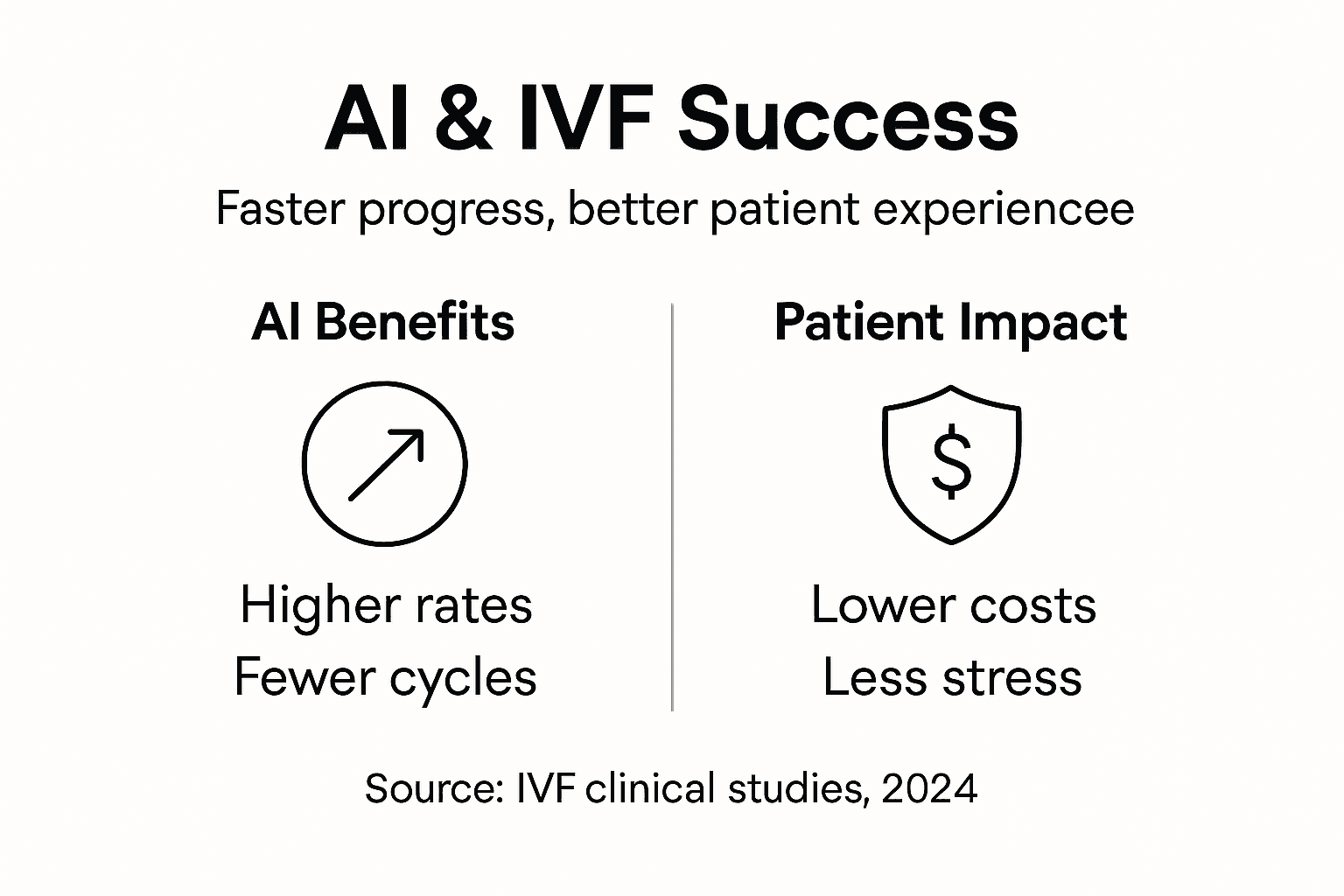
The financial implications of AI integration are equally compelling. Treatment efficiency plays a crucial role in reducing overall medical expenses, as AI enables more targeted and precise interventions. By minimizing unnecessary procedures, optimizing embryo selection, and reducing the number of required treatment cycles, AI has the potential to substantially lower the economic burden on patients. Traditional IVF treatments often involve multiple expensive cycles, but AI-driven approaches can potentially decrease total treatment costs by identifying the most promising embryos and personalizing treatment protocols.
Advanced outcome prediction models are revolutionizing patient expectations by providing more accurate forecasts of potential pregnancy success. These sophisticated algorithms analyze multiple complex variables including genetic markers, patient history, and embryo quality, offering patients a more transparent and data-driven understanding of their fertility journey. By reducing uncertainty and providing clearer insights, AI helps patients make more informed decisions about their treatment options, potentially reducing emotional stress and financial risk.
Pro Tip: Request a comprehensive breakdown of your potential treatment success probability using AI-powered predictive models, and discuss how these insights can help you develop a more strategic approach to your fertility treatment.
Risks, Bias, and Ethical Challenges
As Artificial Intelligence becomes increasingly integrated into reproductive medicine, critical ethical considerations and potential risks emerge that demand careful scrutiny. Comprehensive ethical frameworks are essential to ensure responsible AI implementation that protects patient rights and prevents unintended systemic biases.
Algorithmic bias represents one of the most significant challenges in AI-driven fertility treatments. Data representation plays a crucial role in determining the accuracy and fairness of AI models. Existing datasets might inadvertently perpetuate historical inequities by underrepresenting certain demographic groups, potentially leading to skewed predictions and unequal treatment outcomes. For instance, AI algorithms trained predominantly on data from specific racial or socioeconomic populations could produce less accurate recommendations for patients from underrepresented backgrounds, thereby potentially exacerbating existing healthcare disparities.
Patient data privacy concerns further complicate the ethical landscape of AI in reproductive medicine. The sensitive nature of genetic and medical information demands robust security protocols and transparent consent mechanisms. Patients must be fully informed about how their data will be used, who can access it, and the potential long-term implications of algorithmic decision-making in their fertility journey. Regulatory frameworks need to evolve rapidly to keep pace with technological advancements, ensuring that AI remains a tool for empowerment rather than a source of potential discrimination or privacy violation.
This table compares key risks and safeguards associated with AI in IVF:
Risk Type | Potential Issue | Safeguard Approach | Benefit to Patients |
Algorithmic Bias | Underrepresentation of demographics | Diverse training datasets | Fairer treatment recommendations |
Data Privacy | Unauthorized access to personal data | Encryption, informed consent | Greater confidentiality |
Clinical Oversight | Overreliance on automated decisions | Combined human-AI assessment | Reliable and balanced outcomes |
Pro Tip: Always request a detailed explanation of the AI algorithms used in your fertility treatment, including their training data sources and potential bias mitigation strategies.
Experience Faster, Smarter IVF with Aurea Fertility
The article highlights how Artificial Intelligence significantly improves IVF success rates, personalizes treatment, and reduces emotional and financial stress. Many patients feel overwhelmed by traditional IVF timelines and uncertainty around embryo selection and treatment efficiency. Key terms like AI-assisted embryo selection, advanced personalization, and predictive success models illustrate how technology can transform your fertility journey by identifying the best embryos and tailoring your treatment to your unique profile.
At Aurea Fertility, we specialize in integrating AI-driven protocols that accelerate your path to pregnancy with precision and care. Our technology supports rapid embryo monitoring and personalized stimulation plans to reduce unnecessary steps and maximize your chances of success. Plus, with 24/7 patient communication and a focus on affordability, we help you navigate your treatment confidently and without delay.
Don’t wait months when you can start a highly personalized, AI-supported IVF journey now. Learn more about how our AI-assisted embryo scoring and fast treatment pathways are designed to improve outcomes and minimize stress. Visit Aurea Fertility today and take the first step toward turning hope into a healthy pregnancy.
Frequently Asked Questions
How does AI improve embryo selection in IVF?
AI enhances embryo selection by using advanced algorithms to analyze multiple parameters such as cellular symmetry, fragmentation rates, and developmental progression, allowing for a more accurate prediction of embryo viability compared to traditional visual assessments.
What are the benefits of AI-based personalization in IVF treatment?
AI-driven personalization allows fertility specialists to tailor treatment protocols to individual patient profiles by analyzing complex data, which can optimize medication dosages and improve success rates by addressing specific patient needs.
How do AI technologies impact IVF success rates and costs?
AI technologies can significantly improve clinical pregnancy rates, with some methods achieving success rates up to 77.3%. Additionally, they enhance treatment efficiency, potentially lowering overall medical expenses by reducing the need for unnecessary procedures and optimizing embryo selection.
What ethical concerns are associated with AI in IVF treatments?
Key ethical concerns include algorithmic bias, where underrepresentation of certain demographics can lead to skewed predictions, and patient data privacy issues, demanding robust security protocols to ensure informed consent and confidentiality.
Recommended
Comments