
Cost-Effective Fertility Solutions: AI’s Impact
- Feb 5
- 7 min read

Facing fertility struggles in a busy city can leave you feeling short on time and searching for answers that fit your budget. The need for cost-effective care is urgent, especially when infertility affects nearly 200 million people worldwide, with major differences in access and affordability across countries. As modern clinics introduce AI-powered assessments and personalized protocols, you can discover faster, affordable fertility solutions designed for your unique journey, blending advanced technology with compassionate support.
Table of Contents
Key Takeaways
Point | Details |
Cost-Effective Solutions | Focus on innovative, affordable fertility treatments to improve accessibility for individuals facing infertility. |
AI Technology Integration | Utilize Artificial Intelligence for personalized assessments and treatment pathways that enhance success rates and reduce costs. |
Economic Evaluation | Emphasize comprehensive analyses that demonstrate the cost benefits of AI-driven fertility solutions. |
Ethical Considerations | Address algorithmic bias and data privacy to maintain patient autonomy and ensure equitable access to fertility treatments. |
Understanding Cost-Effective Fertility Solutions
Infertility impacts nearly 200 million people globally, with significant variations in treatment accessibility and affordability. Cost-effective fertility solutions represent a critical approach to addressing these widespread reproductive health challenges. Global reproductive health research highlights the urgent need for innovative, affordable treatment strategies that can help more individuals build their families.
Modern fertility solutions focus on several key optimization strategies:
Simplified medical protocols
Mild ovarian stimulation techniques
Advanced AI-driven assessment methods
Reduced diagnostic and treatment timeframes
Lower-cost intervention pathways
Technology plays a transformative role in making fertility treatments more accessible. Artificial Intelligence enables precise, personalized assessments that can significantly reduce unnecessary testing and procedural costs. By leveraging machine learning algorithms, clinics can create tailored treatment plans that maximize success rates while minimizing financial burden.
Economic considerations remain paramount in fertility care. Recent studies demonstrate that comprehensive fertility treatments can be cost-beneficial, particularly for women under 42 years old. The emerging approach emphasizes creating comprehensive frameworks that reflect the unique goal of fertility treatments: generating new life.
Pro tip: Schedule a comprehensive yet focused fertility assessment that uses AI technologies to create a precise, cost-effective treatment pathway.
Types of AI-Driven Fertility Treatments
Artificial Intelligence is revolutionizing fertility treatments through advanced technological interventions across multiple clinical domains. AI-powered fertility technologies are transforming traditional approaches by providing objective, data-driven decision support throughout the reproductive healthcare process.
Key types of AI-driven fertility treatments include:
Follicular Monitoring
Real-time tracking of ovarian follicle development
Precise measurement of follicle size and maturity
Oocyte Assessment
Automated evaluation of egg quality
Predictive analysis of potential fertilization success
Embryo Selection
Machine learning algorithms ranking embryo viability
Genetic and morphological screening
Predictive Outcome Modeling
Pregnancy probability calculations
Personalized treatment pathway recommendations
Machine learning algorithms enable clinicians to extract implicit knowledge from complex clinical datasets. Advanced AI classification systems can predict patient pregnancy outcomes with remarkable accuracy, allowing for more targeted and efficient fertility interventions.
These technological innovations represent a significant leap forward in reproductive medicine, offering unprecedented precision and personalization in fertility treatments. By integrating sophisticated data analysis and predictive modeling, AI is helping patients achieve their family-building goals more effectively than ever before.
Pro tip: Request a comprehensive AI-assisted fertility assessment that leverages multiple predictive technologies to optimize your treatment strategy.
How AI Enhances IVF Success Rates
Artificial Intelligence has emerged as a game-changing technology in reproductive medicine, dramatically improving the precision and effectiveness of in vitro fertilization (IVF) treatments. AI-powered embryo assessment techniques are revolutionizing how clinicians evaluate and select the most viable embryos, significantly increasing the chances of successful pregnancy.
Key ways AI enhances IVF success rates include:
Embryo Morphology Analysis
Advanced image recognition algorithms
Objective assessment of embryo quality
Reduction of human error and subjective interpretation
Predictive Outcome Modeling
Machine learning algorithms predicting pregnancy probabilities
Personalized treatment recommendations
Early identification of potential challenges
Time-Lapse Embryo Monitoring
Continuous tracking of embryo development
Detailed genetic and cellular performance evaluation
Real-time insights into embryo potential
Machine learning models provide unprecedented accuracy in embryo selection, consistently outperforming traditional human assessments. By analyzing multiple data points including morphological characteristics, genetic markers, and developmental progression, AI can identify subtle indicators of embryo viability that might escape human observation.

Comprehensive AI technologies are transforming fertility treatments from a hit-or-miss approach to a precision-driven, data-informed strategy. These innovations not only improve success rates but also reduce emotional and financial stress for patients seeking to build their families.
Here’s a comparison of conventional IVF versus AI-enhanced IVF treatments:
Aspect | Conventional IVF | AI-Enhanced IVF |
Embryo Selection | Manual assessment, subjective | Data-driven, reduced bias |
Diagnostic Accuracy | Relies on clinician expertise | Advanced predictive modeling |
Treatment Personalization | Limited by protocols | Individualized, adaptive plans |
Success Rate | Variable, depends on clinic | Higher, more consistent |
Cost Efficiency | More cycles often required | Fewer cycles, cost savings |
Pro tip: Ask your fertility specialist about AI-assisted embryo selection techniques that can maximize your chances of successful pregnancy.
Personalization and Rapid Treatment Pathways
Artificial Intelligence has transformed fertility treatments by introducing unprecedented levels of personalization and speed. AI technologies enable precise individualized protocols that dramatically reduce treatment timelines and optimize patient outcomes.
Key aspects of personalized AI-driven fertility pathways include:
Individual Patient Profiling
Comprehensive genetic and medical history analysis
Predictive risk assessment
Tailored treatment strategy development
Dynamic Protocol Optimization
Real-time treatment adjustments
Adaptive ovarian stimulation protocols
Continuous performance monitoring
Predictive Analytics
Machine learning outcome predictions
Personalized success probability calculations
Early intervention recommendations
Predictive modeling allows clinicians to design treatment plans with remarkable precision. Machine learning models provide advanced decision support by analyzing complex clinical data, enabling faster and more accurate fertility interventions tailored to each patient’s unique physiological characteristics.
These technological innovations represent a significant leap forward in reproductive medicine, offering patients streamlined, personalized care that reduces emotional and financial stress while improving overall treatment effectiveness.
Pro tip: Request a comprehensive AI-powered fertility assessment that provides a personalized, rapid treatment pathway specific to your individual reproductive health profile.
Comparing Costs and Potential Savings
Cost management is a critical consideration in fertility treatments, with advanced AI technologies offering significant opportunities for financial optimization. Publicly funded IVF evaluations demonstrate that strategic treatment approaches can maximize economic value while maintaining high-quality patient care.
Key cost comparison and savings strategies include:
Treatment Cycle Efficiency
Reducing unnecessary diagnostic tests
Minimizing invasive procedures
Optimizing treatment protocols
AI-Driven Cost Reduction
Precision embryo selection
Personalized treatment planning
Improved first-attempt success rates
Economic Evaluation Metrics
Cost per live birth calculation
Treatment pathway optimization
Comparative intervention assessment
Economic frameworks are evolving to capture the true value of fertility interventions. Simplified economic evaluation methods now emphasize cost control while maintaining high success rates, suggesting that targeted, data-driven approaches can significantly reduce overall treatment expenses.
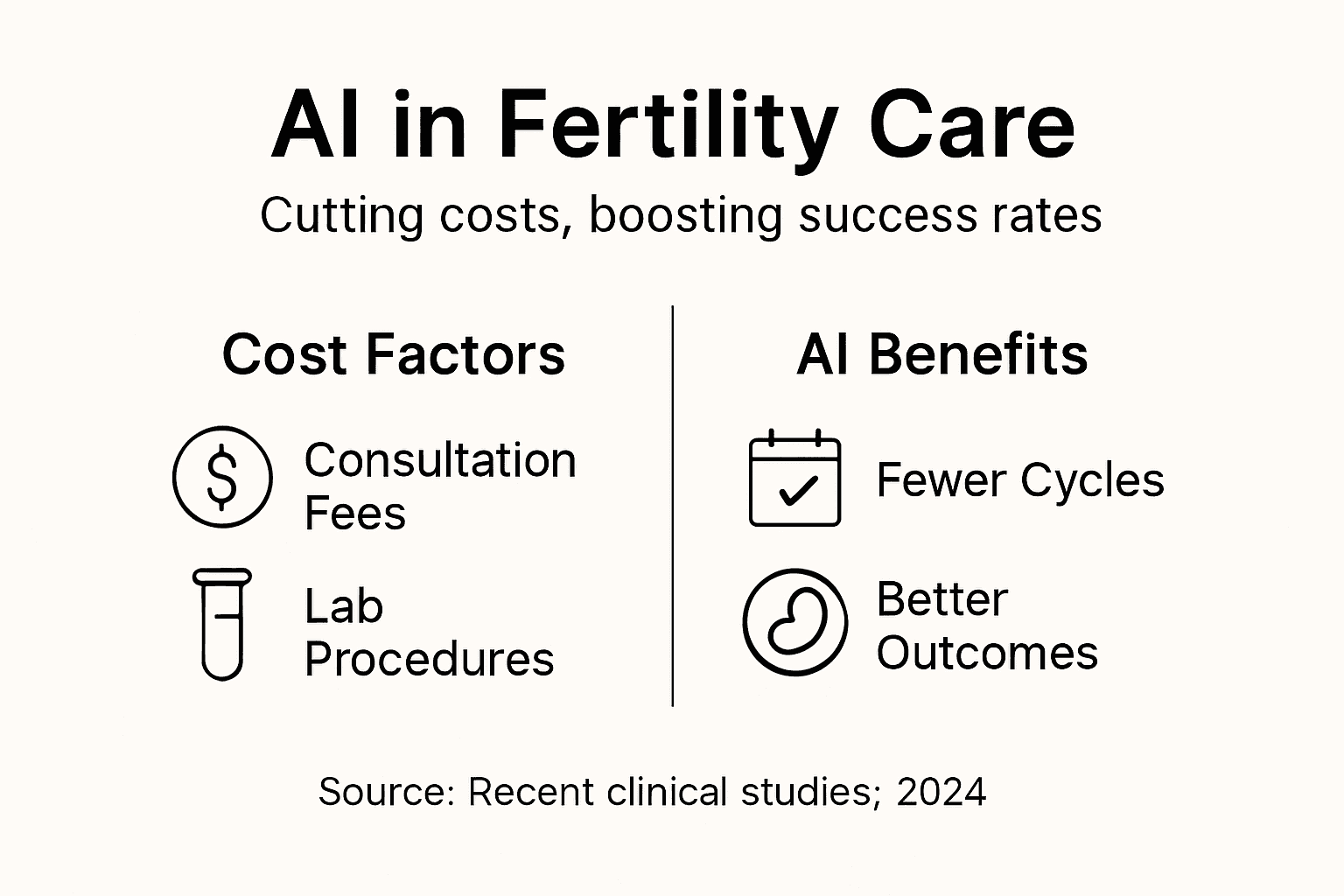
By leveraging AI technologies, patients can potentially save thousands of dollars through more precise, efficient treatment strategies that reduce the number of required cycles and improve overall reproductive outcomes.
Pro tip: Request a comprehensive cost-benefit analysis of your fertility treatment plan that incorporates AI-driven optimization techniques.
Risks, Ethical Issues, and Patient Support
The integration of artificial intelligence in fertility treatments presents complex ethical considerations that demand careful navigation. Ethical challenges in AI embryo assessment raise critical questions about maintaining human dignity and professional medical standards.
Key ethical concerns and support strategies include:
Algorithmic Bias Risks
Potential discrimination in treatment recommendations
Unequal representation in training datasets
Systematic disparities in patient outcomes
Data Privacy Protection
Secure patient information management
Transparent data usage policies
Consent-driven personal health information handling
Patient Autonomy Preservation
Maintaining human decision-making authority
Comprehensive informed consent processes
Clear communication about AI’s role
Patient support mechanisms are crucial in addressing technological uncertainties. Global health governance frameworks emphasize the importance of equitable access and patient-centered approaches that prioritize individual needs and rights.
Responsible AI implementation requires ongoing dialogue between patients, clinicians, and technologists to ensure that reproductive technologies remain compassionate, transparent, and fundamentally human-focused.
The following table summarizes major ethical considerations and patient safeguards in AI-assisted fertility treatments:
Ethical Issue | AI Risk Example | Patient Safeguard |
Algorithmic Bias | Uneven embryo ranking | Diverse data, fairness audits |
Data Privacy | Unauthorized information use | Secure systems, robust consent |
Patient Autonomy | Overdependence on AI advice | Human oversight, clear guidance |
Pro tip: Always request a detailed explanation of how AI will be used in your specific treatment plan and maintain open communication with your healthcare provider.
Experience Personalized, Cost-Effective Fertility Care with AI Innovation
The challenge of managing fertility treatment costs while achieving the best possible outcomes is real and emotionally taxing. This article highlights key pain points such as the need for simplified medical protocols, personalized treatment strategies, and AI-driven embryo selection to reduce unnecessary procedures and expenses. At Aurea Fertility, we understand the urgency to deliver rapid, efficient pathways that leverage advanced artificial intelligence technologies for precise assessments and higher success rates designed especially for women and couples seeking affordable solutions.
By combining state-of-the-art AI tools with dedicated human support, Aurea Fertility transforms traditional fertility care into a streamlined experience that can shorten treatment timelines from months to just weeks. From AI-assisted embryo monitoring to personalized ovarian stimulation protocols, our approach minimizes emotional and financial stress and maximizes your chance to build a family. Learn more about our innovative solutions on Aurea Fertility and explore how our AI-powered fertility assessment can create a tailored, cost-effective treatment plan just for you.
Take the first step toward a future of compassionate, technology-driven fertility care. Visit Aurea Fertility today and start your journey with confidence!
Frequently Asked Questions
What are cost-effective fertility solutions?
Cost-effective fertility solutions are innovative approaches that make fertility treatments more accessible and affordable, focusing on simplified medical protocols, mild ovarian stimulation, and the use of AI technologies to reduce costs and improve success rates.
How does AI improve fertility treatment outcomes?
AI enhances fertility treatments by providing precise data analysis, personalized assessments, and predictive modeling. This allows for individualized treatment plans that maximize chances of success while minimizing unnecessary procedures and interventions.
What types of AI-driven fertility treatments are available?
AI-driven fertility treatments include follicular monitoring, oocyte assessment, embryo selection through machine learning algorithms, and predictive outcome modeling to assess pregnancy chances and optimize treatment pathways.
How can I assess the cost savings of AI in fertility treatments?
Cost savings can be evaluated through analyzing treatment cycle efficiency, the precision of embryo selection, and improved success rates. A comprehensive cost-benefit analysis of your treatment plan can highlight potential savings from AI-driven optimizations.
Recommended
Comments