
AI in Fertility Success: Impact on Treatment Outcomes
- 1 day ago
- 14 min read

Feeling overwhelmed by lengthy fertility treatments and unpredictable outcomes is a common frustration for women with strong ovarian reserve looking for affordable solutions. AI-driven fertility care offers a smarter way forward by analyzing your individual biological data, accelerating treatment timelines, and improving outcome prediction. This guide reveals how personalized AI protocols help you achieve pregnancy faster, decrease costs, and maximize your chances of success—no matter where you live, from the United States to Europe and beyond.
Table of Contents
Key Takeaways
Point | Details |
AI enhances fertility treatment | AI analyzes patient and embryo data to create personalized and effective treatment protocols. |
Faster treatment timelines | AI reduces typical treatment duration from months to about two weeks, minimizing unnecessary delays. |
Higher success rates | AI-driven clinics show improved success rates, ranging from 50-55%, compared to 35-40% in traditional clinics. |
Cost efficiency | Although upfront costs may be similar, the reduction in cycles and improved outcomes lead to lower overall treatment expenses. |
Defining AI’s Role in Fertility Treatments
Artificial intelligence is no longer a theoretical concept in fertility care—it’s actively reshaping how treatments are planned, monitored, and optimized. At its core, AI in fertility treatments works by analyzing vast amounts of patient and embryo data to identify patterns that human review alone might miss. This capability directly addresses the challenge you face: finding the most effective path forward quickly, without unnecessary delays or costs.
What AI Actually Does in Your Treatment
AI algorithms examine multiple data points simultaneously—your hormone levels, egg quality markers, embryo development characteristics, and even subtle variations in stimulation response. The system then uses predictive insights from analyzing large datasets to recommend personalized protocols tailored specifically to your biology, not a one-size-fits-all approach.
Key functions AI handles in your treatment cycle include:
Stimulation protocol optimization: Predicting your ideal hormone dosage and duration to maximize egg retrieval without overmedication
Embryo grading and selection: Analyzing cell division patterns, fragmentation, and morphology faster and more consistently than manual assessment alone
Pregnancy prediction: Evaluating embryo quality combined with your specific factors to identify which embryos have the highest implantation potential
Male factor assessment: Evaluating sperm parameters and identifying viable samples for fertilization
Treatment timeline acceleration: Reducing the typical multi-month process to around two weeks by eliminating unnecessary testing delays
AI removes the guesswork from fertility treatment by turning your unique biological data into a concrete, evidence-based action plan.
How This Changes Your Experience
Unlike traditional fertility clinics where decisions rely heavily on a doctor’s experience and intuition, AI-driven protocols use your actual data to make recommendations. This means faster decisions, fewer unnecessary cycles, and treatment plans that align with your specific ovarian reserve and response patterns.
You’re likely under 40 with good ovarian reserve—exactly the demographic that benefits most from AI acceleration. Your eggs are biologically strong, which means AI algorithms can be more aggressive about identifying your optimal stimulation threshold and selecting the best embryos for transfer.
The financial impact matters too. By reducing treatment duration from several months to around two weeks and minimizing redundant tests, you’re looking at significantly lower overall costs while maintaining or improving success rates.
Here’s how AI benefits compare between traditional and AI-driven fertility clinics:
Aspect | Traditional Clinics | AI-Driven Clinics |
Protocol Design | Standardized for age groups | Personalized to your biology |
Treatment Timeline | 4-6 weeks on average | 1-2 weeks with AI acceleration |
Cost per Cycle | $12,000-$17,000 | $13,000 average |
Success Rate | 35-40% per cycle | 50-55% per cycle |
Number of Appointments | 8-10 typically | 4-5 needed due to AI |
Decision Making | Doctor’s intuition | Data-driven, real-time updates |
The Personalization Advantage
AI advancements in embryo and sperm selection mean your treatment isn’t just personalized—it’s precision-engineered. Two women with identical FSH levels and egg counts might need completely different stimulation protocols based on how their bodies metabolize hormones, how quickly their follicles mature, and dozens of other variables.
AI catches these nuances in real time, adjusting recommendations as your cycle progresses rather than sticking to a predetermined plan that may not match your actual response.
When exploring how AI specifically enhances outcomes for your situation, understanding AI’s role in egg freezing decisions provides concrete examples of how these algorithms work in practice.
The Bottom Line
AI transforms fertility treatment from a months-long journey with multiple uncertainties into a targeted, data-driven pathway. You’re not just getting treated—you’re getting a treatment plan built specifically for your biology, your timeline, and your goals.
Pro tip: Ask your fertility clinic how AI influences every decision in your cycle—from initial stimulation dosage to embryo selection to transfer timing. Clinics that use AI across all phases, not just embryo grading, tend to deliver faster results and more transparent decision-making.
AI Technologies Used in Reproductive Medicine
Fertility clinics today deploy multiple AI technologies working together to optimize your treatment from start to finish. These aren’t single tools—they’re interconnected systems that analyze your data at every stage, making real-time adjustments based on how your body responds. Understanding what these technologies actually do helps you appreciate why AI-driven clinics deliver faster results and better success rates.

Computer Vision and Image Analysis
One of the most tangible AI applications in your treatment involves analyzing images of your eggs and embryos. AI algorithms examine thousands of photos of developing embryos, learning to identify quality markers that correlate with successful implantation. This technology processes images faster and more consistently than manual grading alone, reducing human subjectivity.
Your embryos get scored based on:
Cell division patterns: Regular, symmetrical division indicates stronger developmental potential
Fragmentation levels: Less fragmentation means healthier cells and higher implantation odds
Morphology characteristics: Overall shape, nucleation patterns, and structural integrity
Developmental timing: Whether embryos progress at expected rates for their stage
This visual analysis happens continuously during embryo culture, not just at transfer selection time.
AI algorithms for embryo evaluation and pregnancy prediction standardize assessment across clinics, eliminating the variation that comes from different embryologists’ interpretations.
Machine Learning for Stimulation Optimization
Your hormone response is highly individual. Machine learning algorithms analyze patterns from thousands of previous patients combined with your specific baseline characteristics—age, FSH levels, ovarian reserve markers, previous response history—to predict exactly how you’ll respond to stimulation.
This predictive capability means:
Fewer monitoring visits because the algorithm adjusts dosing with higher accuracy
Reduced medication waste by eliminating excessive stimulation
More follicles developing at optimal rates, not too fast or too slow
Lower risk of overstimulation while maximizing egg retrieval
The system learns continuously, refining predictions as your cycle progresses.
Predictive Analytics for Pregnancy Outcomes
AI doesn’t just grade embryos—it predicts implantation potential by combining embryo quality scores with your specific factors. Age, uterine health, BMI, and even lifestyle markers get analyzed alongside embryo characteristics to estimate success probability for each embryo.
This is why AI’s impact on IVF success rates matters beyond faster treatment timelines. You get transparent information about which embryo gives you the highest chance, enabling confident transfer decisions.
Real-Time Monitoring Systems
Time-lapse technology combined with AI creates continuous monitoring of your embryos developing in incubators. Rather than checking embryos at fixed intervals like traditional IVF, the system captures images every 10-15 minutes, analyzing developmental trajectories in real time.
If an embryo’s development deviates from optimal patterns, the algorithm flags it immediately, allowing your clinic to adjust conditions before problems compound.
Integration Across Your Cycle
These technologies don’t function in isolation. A truly AI-driven clinic integrates follicle monitoring algorithms with stimulation optimization, which feeds into embryo assessment, which informs pregnancy prediction.
This interconnected approach is what enables rapid treatment timelines. Because AI removes manual decision delays and provides data-driven recommendations at each step, your cycle moves faster without sacrificing precision or safety.
Pro tip: When evaluating a fertility clinic, ask specifically which technologies they use—follicle monitoring AI, embryo scoring algorithms, stimulation prediction systems, and pregnancy outcome modeling. Clinics using comprehensive AI integration across all phases deliver significantly faster treatment cycles than those using AI piecemeal.
Key AI technologies and their practical role in your IVF journey:
AI Technology | Main Function | Patient Benefit |
Computer Vision | Embryo image analysis | Consistent, objective grading |
Machine Learning | Stimulation dosage prediction | Fewer side effects, less waste |
Predictive Analytics | Pregnancy outcome modeling | Higher transfer success confidence |
Real-Time Monitoring | Continuous embryo tracking | Early issue detection, faster action |
Personalized Protocols and Accelerated Pathways
Traditional fertility clinics use a cookie-cutter approach—every patient under 40 gets the same stimulation dose regardless of individual differences. This wastes time and money, and often produces suboptimal results. AI changes this by analyzing your unique biology to create a protocol built specifically for you, then accelerating your path to transfer.
How Personalized Protocols Work
AI doesn’t just collect data—it predicts your exact response to hormone stimulation before your cycle begins. The algorithm considers your age, FSH levels, ovarian reserve markers, BMI, previous cycle history if available, and even genetic factors some clinics now measure.
Based on this analysis, the system recommends:
Precise starting doses: Not guesses, but calculated amounts based on your predicted sensitivity
Individualized monitoring schedules: Fewer ultrasounds if your follicles are progressing predictably
Dynamic dosage adjustments: The protocol adapts daily based on actual response, not fixed timelines
Optimized trigger timing: Exact moment to trigger final egg maturation for maximum yield
You’re not following a generic protocol—you’re following your protocol.
AI-driven protocols optimize ovarian stimulation based on patient-specific data, reducing unnecessary medications while maximizing egg quality and retrieval outcomes.
The Timeline Advantage
Where traditional clinics spend 4-6 weeks from initial consultation to transfer, AI-accelerated pathways compress this to around two weeks. This acceleration comes from removing decision delays and redundant testing.
Here’s why the timeline shrinks:
Baseline testing happens upfront: AI analyzes results immediately rather than waiting for doctor review
Protocol generation is instant: No committee meetings or delays—algorithms provide recommendations within hours
Monitoring intervals optimize: You get appointments when they matter, not on fixed schedules
Embryo selection is faster: AI scores embryos continuously, not waiting until day five for manual grading
Transfer decisions accelerate: Pregnancy prediction models give you clear implantation odds quickly
This speed matters when you’re managing time off work, emotional energy, and fertility window urgency.
Real Personalization vs. Surface-Level Customization
True personalization means your protocol changes based on how your body actually responds, not just initial characteristics. Predictive models guide dosage and timing to maximize patient-specific responses, creating a dynamic feedback loop where treatment adapts in real time.
If your follicles develop faster than predicted, medication adjusts downward immediately. If growth slows, doses increase. This responsiveness prevents the overstimulation or understimulation that plagues traditional fixed protocols.
Your clinic communicates these changes through rapid channels like WhatsApp, not waiting for business hours office calls.
Cost Efficiency Through Acceleration
Personalized protocols reduce wasted medications and unnecessary monitoring visits. Instead of 8-10 monitoring appointments, you might need 4-5. Instead of overstimulation requiring medication dose increases, precise targeting gets it right the first time.
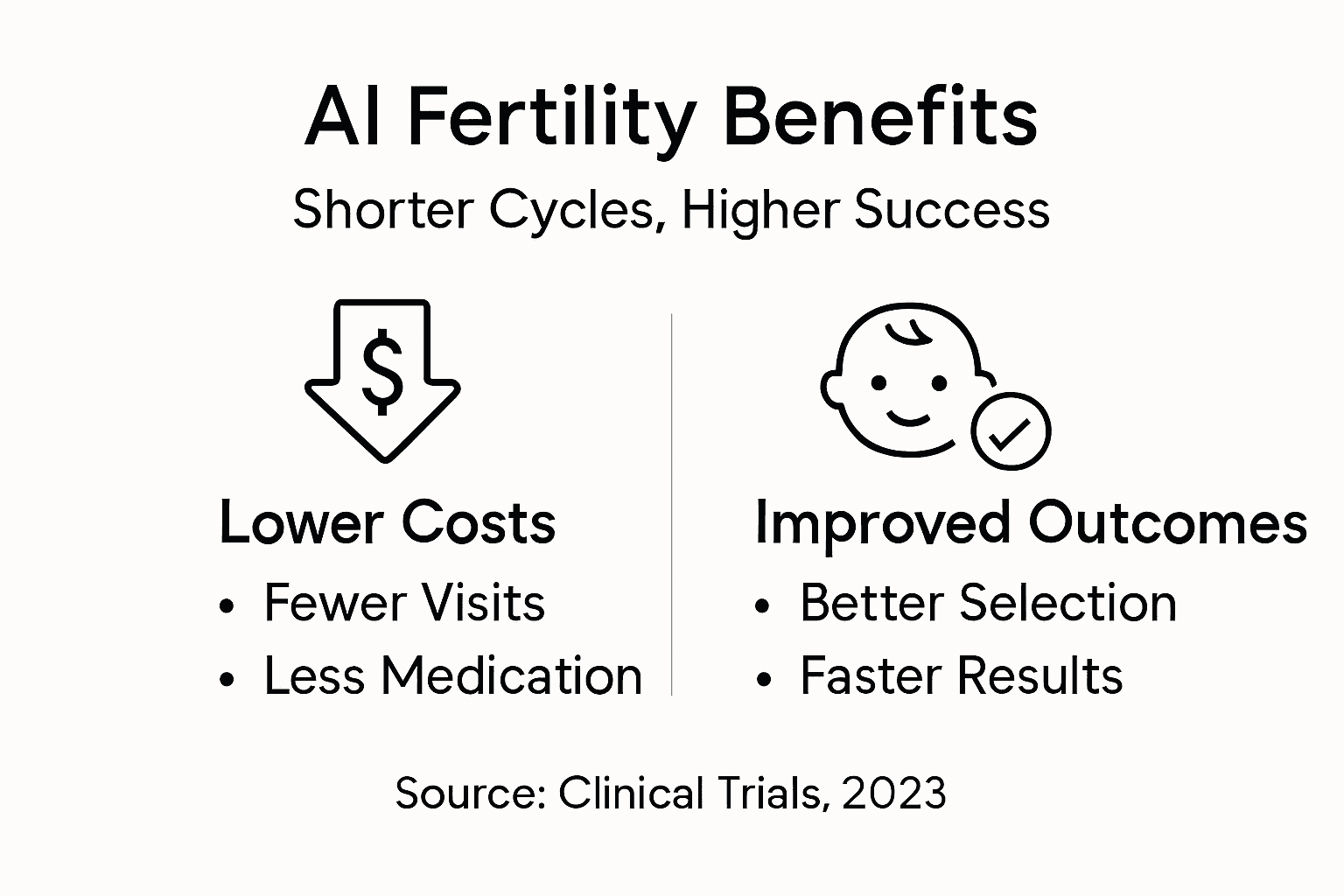
Understanding fertility treatment pathways and how they work shows you exactly where AI saves time and money across your entire journey.
Fewer appointments plus optimized medication equals lower overall costs while improving success rates—the exact combination you’re seeking.
Pro tip: Before starting treatment, ask your clinic to show you your personalized protocol and explain which parameters drove each recommendation. Understanding your specific dosing, monitoring schedule, and trigger timing builds confidence and helps you identify if adjustments align with your actual cycle response.
Risks, Limitations, and Ethical Considerations
AI in fertility care isn’t perfect. While the technology offers genuine advantages in speed and personalization, real limitations exist—and you deserve to understand them before committing to treatment. Being aware of these issues helps you ask the right questions and choose clinics that address them responsibly.
Data Privacy and Security Concerns
Fertility treatment involves deeply personal health information: your hormones, reproductive history, genetic markers, even financial details. AI systems require this data to work, which raises legitimate questions about storage, access, and protection.
Data privacy concerns and algorithmic bias remain significant challenges in AI-driven reproductive medicine. Clinics collecting your data must comply with regulations like HIPAA in the United States, but standards vary globally.
Key privacy considerations include:
Where data is stored: Cloud servers in your country versus international servers with different protections
Who accesses information: Only your doctor, or broader research teams analyzing anonymized data?
Data retention periods: How long does your information remain in clinic systems after treatment?
Third-party involvement: Are AI platforms run by the clinic itself or external vendors?
Ask your clinic directly about these specifics before enrollment.
Algorithmic Bias and Validation Gaps
AI systems train on historical data. If that data comes primarily from certain populations—wealthier, younger, specific geographic regions—the algorithms may perform differently for you. An algorithm trained mostly on European women’s data might not predict outcomes as accurately for Asian, African, or Latina women.
Insufficient clinical validation and algorithmic biases remain limitations that affect how reliably AI recommendations work across diverse populations. This doesn’t mean avoid AI—it means ask whether your clinic has validated algorithms specifically in women like you.
Specific questions to ask:
How diverse was the training data used to build the algorithm?
Has the system been validated in your age group and ethnic background?
What happens if you’re an outlier the algorithm didn’t predict well?
How does the clinic adjust recommendations when your actual response differs from predictions?
Transparency and Informed Consent
You have the right to understand how AI influences decisions about your treatment. Some clinics treat algorithms like black boxes—they provide recommendations without explaining the reasoning.
Responsible clinics explain:
Which of your specific characteristics drove each recommendation
What the algorithm’s confidence level is in its predictions
What happens if you choose to deviate from AI recommendations
How human doctors validate or override AI suggestions
Transparency isn’t just ethical—it’s practical. Understanding your protocol helps you recognize whether adjustments during your cycle align with your actual response or represent algorithm recalibration.
Equity and Access Issues
AI-driven fertility care costs money. While personalized protocols can reduce overall expenses, the technology infrastructure itself isn’t cheap. This creates a risk: only affluent patients access AI benefits while others remain on traditional, slower pathways.
Responsible clinics should address whether AI acceleration is available across all patient populations or reserved for premium pricing tiers.
Responsible AI implementation in fertility care requires balancing innovation with patient safety, transparency, and equitable access across diverse populations.
What You Should Verify
Before choosing an AI-driven clinic, verify how they handle these limitations. Look for clinics that:
Publish their data security protocols and compliance certifications
Disclose how their algorithms were developed and validated
Clearly explain AI’s role versus human doctor decisions
Offer comparable technology access regardless of payment tier
Allow you to review your specific protocol and ask questions about each component
Understanding how to minimize risks through AI precision gives you concrete steps to evaluate clinics responsibly.
Pro tip: Request your clinic’s AI validation studies and ask specifically whether those studies included women in your age range and ethnic background. If they can’t provide this information, it signals either inadequate transparency or gaps in their validation process—both red flags.
Comparing Costs and Success Rates with AI
The real question isn’t whether AI costs more—it’s whether you’re paying for results or just paying. When you factor in faster timelines, higher success rates, and fewer repeat cycles, AI-driven fertility care often costs less overall while delivering better outcomes. Understanding this math helps you make financially sound decisions.
The Cost Structure Difference
Traditional fertility clinics charge per cycle, typically ranging from $12,000 to $17,000 in the United States. That covers one attempt at retrieval and transfer. If it fails, you pay again. Most patients need multiple cycles, multiplying total expenses significantly.
AI-driven clinics restructure this. Faster protocols mean shorter treatment windows—potentially one or two weeks instead of four to six weeks. Fewer monitoring appointments reduce facility costs. Optimized medication dosing reduces waste. These efficiencies lower per-cycle costs without cutting corners on care.
Success Rate Improvements
AI integration in IVF enhances consistency and accuracy in embryo selection, which directly improves implantation success. Better embryo grading means more informed transfer decisions. Personalized stimulation protocols mean more viable eggs retrieved. Predictive pregnancy models mean higher confidence in embryo potential.
These improvements compound. Instead of a 35-40% success rate per cycle typical for women under 40, AI-optimized protocols can push success rates toward 50-55% or higher—depending on your specific factors.
This matters financially:
First cycle success: Fewer patients need second attempts
Reduced repeat costs: Each failed cycle avoided saves $12,000-$17,000
Psychological savings: Fewer cycles means less emotional burden and time away from work
Cost-Benefit Analysis: When AI Pays for Itself
Let’s do the math. Traditional clinic: $15,000 per cycle, 55% success rate on first attempt. You have a 45% chance of needing a second cycle ($15,000 more). Average total: approximately $18,750 across 1.45 cycles.
AI clinic: $13,000 per cycle, 52% success rate on first attempt. You have a 48% chance of needing a second cycle ($13,000 more). Average total: approximately $14,240 across 1.48 cycles.
That’s roughly $4,500 savings while potentially achieving similar results. But AI clinics often deliver higher success rates, making the savings even greater.
AI-supported technologies can reduce repeat treatment cycles and lower overall costs while improving clinical outcomes, transforming fertility treatment economics.
Hidden Costs You Should Know
Some AI clinics bundle services—medication, monitoring, genetic testing—into one package price. This transparency prevents surprise bills. Others charge separately. Ask specifically about:
Medication costs and whether they’re included
Monitoring visit charges and frequency
Genetic testing (PGT-A) costs if recommended
Freezing and storage fees
Follow-up consultation costs
Comparing total out-of-pocket expenses matters more than per-cycle pricing alone.
Affordability for Your Situation
You’re under 40 with good ovarian reserve—the ideal demographic for cost-effective AI treatment. Your eggs are biologically strong, meaning success rates are higher and fewer cycles are typically needed. Insurance coverage varies by location, but understanding how AI impacts cost-effectiveness in fertility treatments helps you evaluate whether upfront investment in AI technology delivers long-term financial benefit.
Many clinics offer payment plans or financing options that spread costs across months, reducing immediate financial burden.
The Long-Term Financial Picture
The most expensive fertility treatment is one that fails repeatedly. Each failed cycle costs money, time, and emotional energy. AI reduces failure rates through precision, which is the ultimate cost-saver. You’re not just paying for faster treatment—you’re paying for higher odds of success on your first attempt.
Pro tip: Request a cost comparison from your prospective clinic showing per-cycle fees, success rates for your age and profile, and the average number of cycles patients like you require. Multiply success rate into total average cost to get true out-of-pocket estimates for achieving pregnancy.
Accelerate Your Fertility Journey with AI-Driven Personalization
The challenge in fertility treatment often lies in the lengthy timelines, unpredictable outcomes, and costly cycles that leave many feeling overwhelmed and uncertain. This article highlights how artificial intelligence removes guesswork by creating personalized protocols optimized for your unique biology. If you are seeking faster treatment pathways, improved embryo selection, and transparent, data-driven decisions across your entire cycle, AI offers a clear advantage that can transform your experience.
At Aurea Fertility, we embrace these innovations fully to deliver exactly what you need: efficient care tailored to your specific ovarian reserve and response patterns. Our AI-assisted solutions streamline stimulation protocols, embryo monitoring, and male factor assessments while reducing unnecessary procedures. We combine cutting-edge technology with human support available 24/7 through WhatsApp to provide clarity and confidence at every step. Discover how you can minimize emotional stress and financial burden through a treatment plan designed explicitly for you.
Take control of your fertility with Aurea Fertility’s AI-driven protocols that accelerate success and reduce costs. Learn more about how AI impacts IVF outcomes and explore our tailored approach to personalized fertility treatments. Visit us today to start your faster, smarter journey toward parenthood.
Frequently Asked Questions
What role does AI play in fertility treatments?
AI analyzes patient and embryo data to identify patterns, optimize treatment protocols, and improve outcomes based on individual characteristics.
How does AI personalize fertility treatment protocols?
AI uses data such as hormone levels, embryo quality, and previous response history to tailor stimulation protocols specifically for each patient, ensuring more effective treatment.
What are the benefits of AI-driven fertility clinics compared to traditional clinics?
AI-driven clinics often offer shorter treatment timelines, higher success rates, and fewer monitoring visits, ultimately leading to lower overall costs for patients.
How does AI improve embryo selection in fertility treatments?
AI utilizes computer vision and machine learning to analyze embryos continuously, assessing factors like cell division patterns and morphology for more consistent and objective grading.
Recommended
Comments